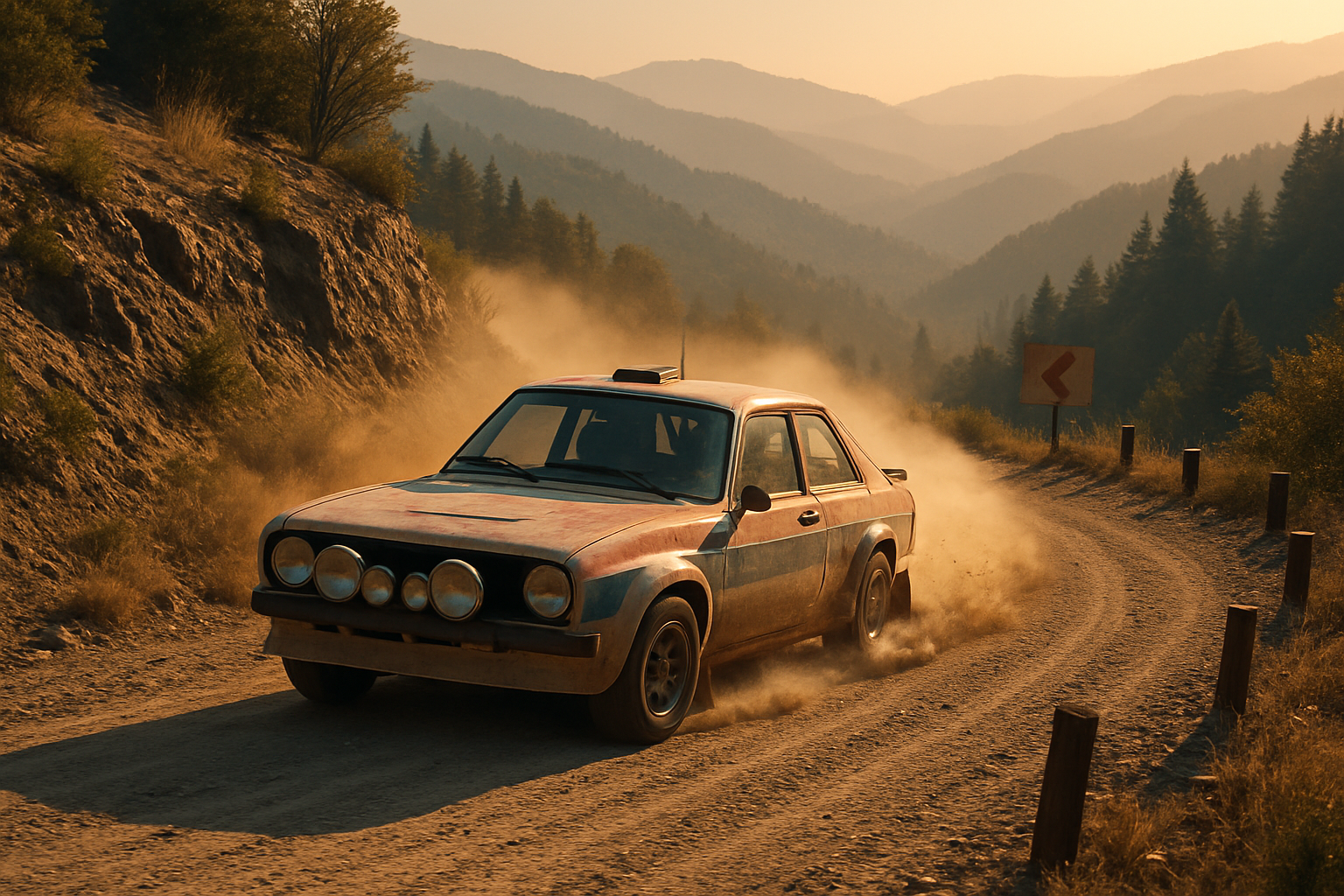
A boxy 1970s rally car on a gravel mountain stage in late afternoon — four auxiliary lamps across the bumper, taped headlights, mudflaps, a livery band down the flank — kicking dust between a rock-cut bank and a line of marker stakes, with ridge after ridge fading into warm haze. Hold the throttle and TWO cars pull away together, because the piece is a physics experiment as much as a drive: one runs on Unity's dedicated WheelCollider suspension, the other on the plain rigid-body recipe this lab already trusts. They race side by side so you can see whether the specialised component actually works in a game assembled entirely from code.
1 · AI conceptConcept prompt
A vintage rally car mid-stage on a gravel mountain road in late afternoon: a boxy 1970s two-door rally car in faded works livery with round auxiliary lamps across the bumper, mudflaps, a roof vent and taped-over headlights, kicking a plume of pale dust as it slides through a right-hander; loose gravel and rutted tracks on the road surface, a rock-cut bank with sparse scrub on the inside of the bend, wooden marker stakes and a faded arrow board on the verge, a steep drop on the outside; behind it ridge after ridge of forested mountains fading into warm afternoon haze, low sun raking across the dust so it glows, long shadows across the road, dry ochre and dusty olive against hazy blue-grey ridges, energetic sunlit mood, high-end stylized 3D game render, no text, no watermark, no UI
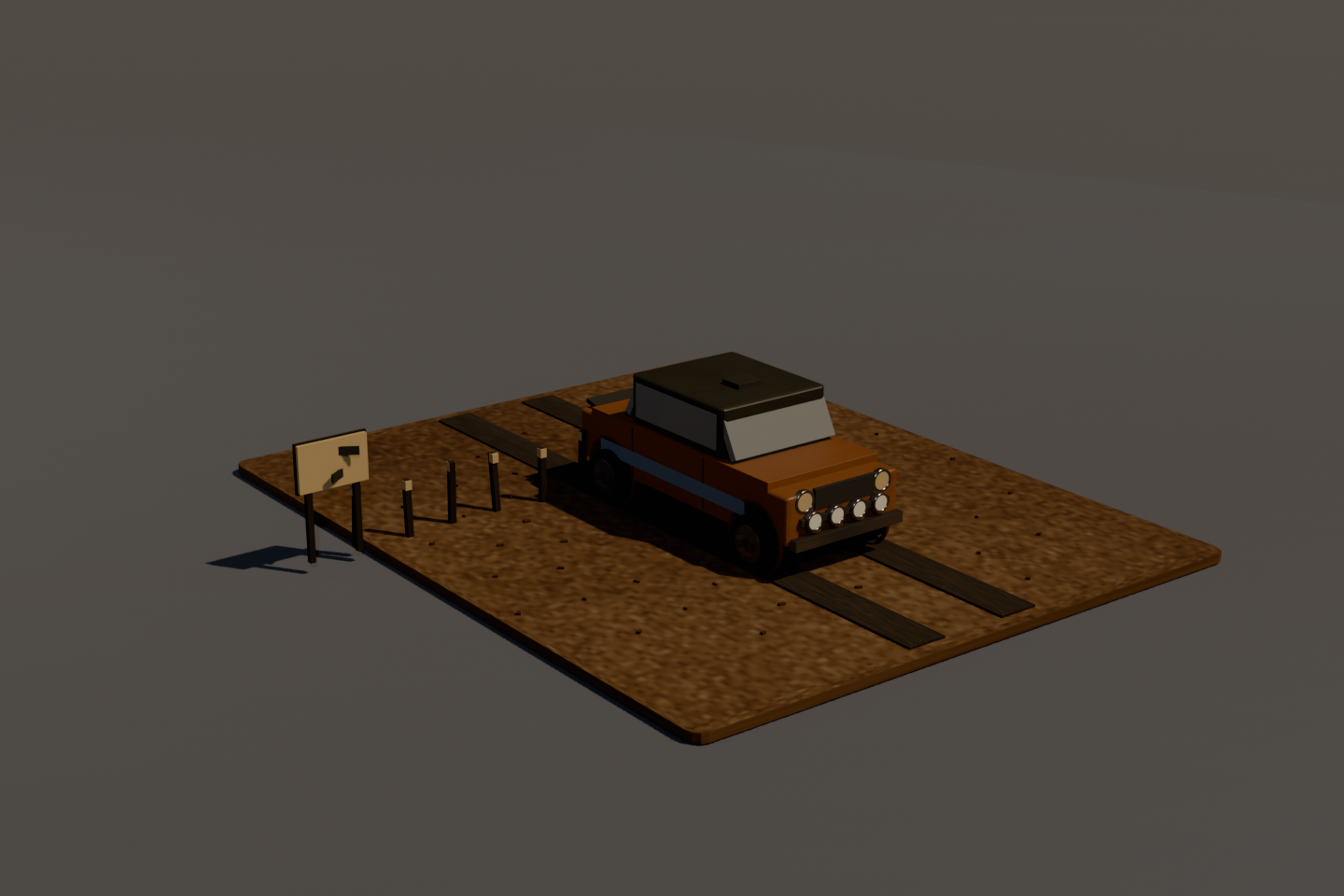
2 · Blender render (code-modeled)
Hold UP or click to drive both cars · R returns them to the start lineOpen fullscreen ↗
Made by AI, compiled by the real Unity 6 engine. The car and the marker stakes are code-modeled Blender exports with named wheel pivots the engine drives; the road, the rock bank, the ridges and the boundary are built in the engine, because terrain is fabric rather than a hero asset. The probe was WheelCollider — Unity's dedicated vehicle component, with its own suspension solver and friction curves, never measured in this lab before. Six earlier cycles found features that look correctly wired and silently do nothing in a code-built WebGL build, so this one shipped with its control alongside it: a second identical car on the plain rigid-body recipe, same start line, same throttle. The answer is that WheelCollider works, and the measurement is unusually clean — over 142 metres the two cars finished within a centimetre of each other, with all four wheels reporting ground contact. Two rounds were lost to a trap worth naming: spawning the car so its wheels rested exactly on the surface made the suspension resolve the contact by launching it to 128 m/s, and the telltale was that 'speed' rising while ground contact read zero — which is not a fast car, it is a falling one. The scene also finally confirmed that distance fog renders in these builds, something two previous night pieces could not test because a near-black room has no contrast for fog to act on. All sound is sampled - never synthesized.