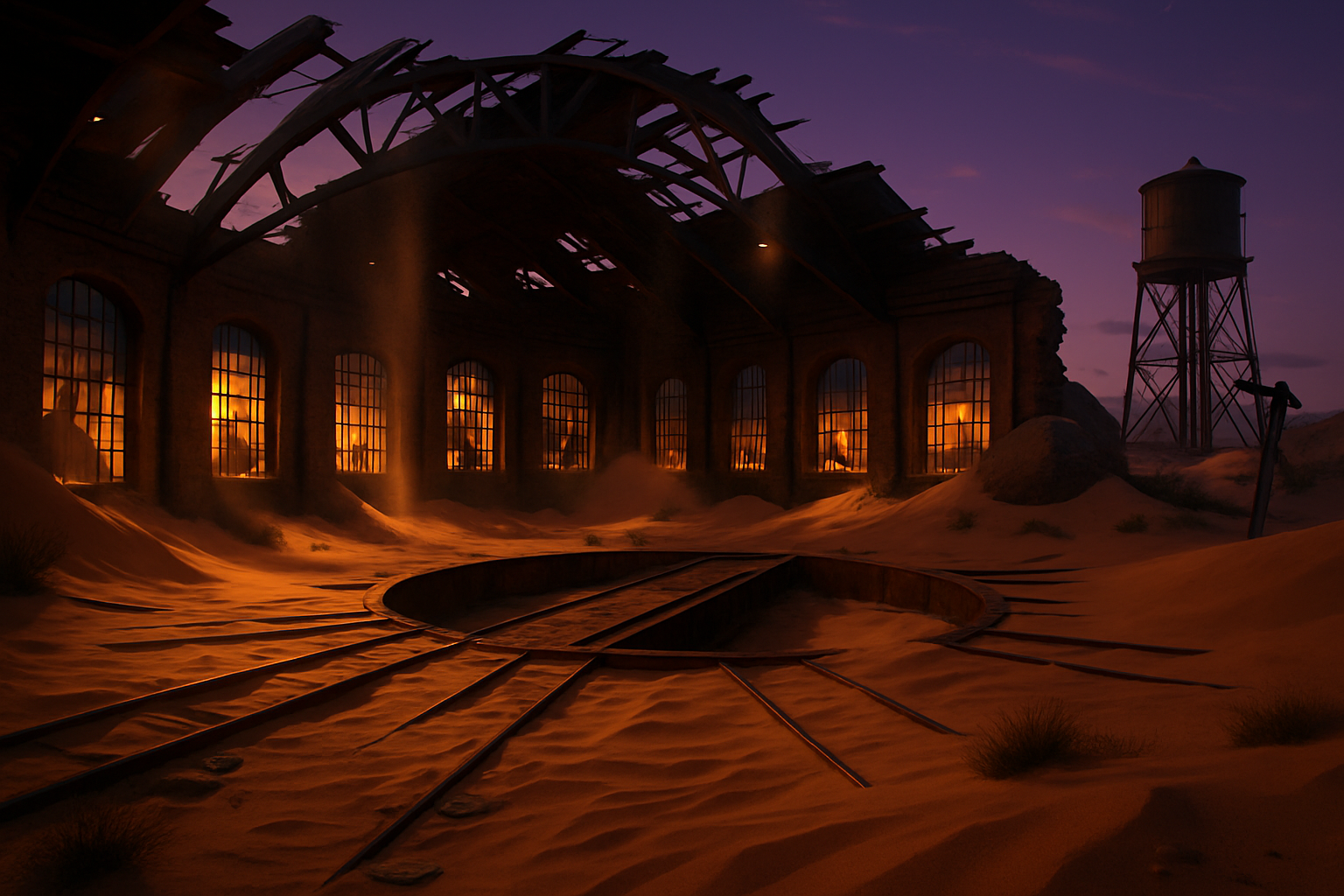
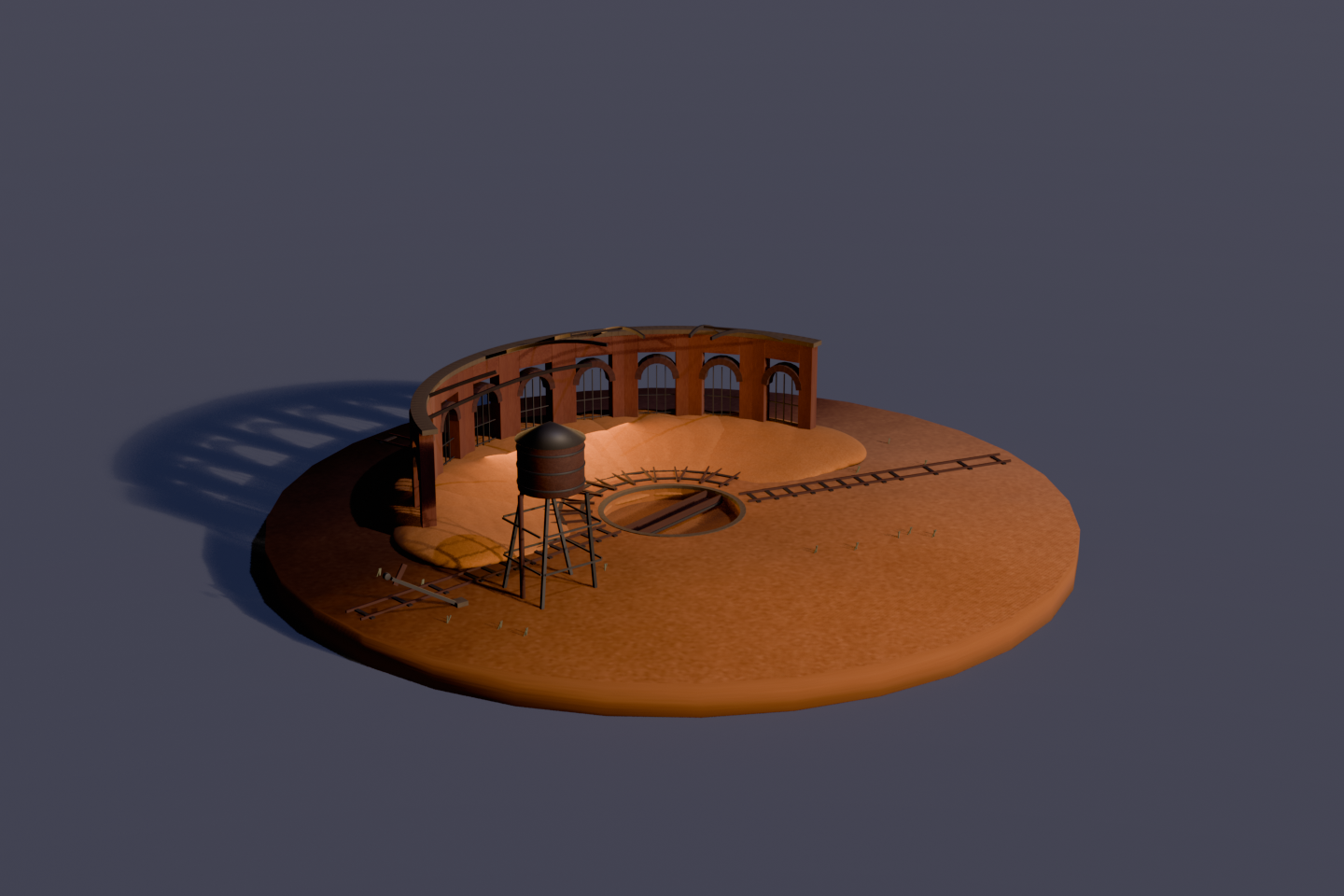
An abandoned semicircular brick engine shed, half-buried in desert dune at dusk. Nine arched bays curve around a collapsed truss roof, a turntable pit sits at the centre with rails radiating out beneath the sand, and a water tower and toppled signal post stand out on the flat. The probe here is GPU instancing: 1700 wind-scoured ballast shards are drawn across the desert floor as two batched calls rather than 2400 GameObjects, and their matrices are rebuilt every frame so the drift actually moves rather than sitting frozen. Press I to switch the field off and watch it vanish. The camera runs its own slow rail through the ruin - the space is the hero here. Low sampled harp, marimba and pad, sparse as a ruin at dusk.
1 · AI conceptConcept prompt
A vast abandoned railway roundhouse reclaimed by a desert at dusk: a huge semicircular brick engine shed with a collapsed sawtooth roof open to a violet sky, one rusted turntable pit at its centre half-buried in rippled orange sand, broken rails radiating outward from the pit like spokes and disappearing under dunes, tall arched brick bays along the curved back wall with shattered windows throwing long shafts of low amber light across the sand floor, drifting dust motes and thin sand streams pouring from roof gaps, a lone rusted water tower and a toppled signal post outside, scrubby desert grass tufts in the sand shadows, deep teal shadows against hot ochre brick, lonely windswept mood, high-end stylized 3D game render, no text, no watermark, no UI
2 · Blender render (code-modeled)
I toggles the instanced shard field - F freezes the camera rail - the ruin runs on its ownOpen fullscreen ↗
Made by AI, compiled by the real Unity 6 engine. This is an ENVIRONMENTS piece, and the engine probe was chosen by measuring the gap: 69 prior cycles had zero coverage of Graphics.DrawMeshInstanced. The concept's defining feature is light shafts through the shattered bays, and light cookies would have been the natural probe - but a cookie needs the URP light-cookie shader variant, and because this scene is built entirely in code at runtime no built scene ever references a cookie light, so the variant would be stripped out of the WebGL player and the probe would have 'failed' for reasons that say nothing about cookies. Instancing rides the already-seeded lit material and cannot be stripped that way, so it is a claim the audit can actually hold to account. The live audit MEASURES it in screen pixels: a plain before-and-after shot would prove nothing because the camera moves and the shards drift, so the piece exposes a key that freezes the rail and another that toggles the field, and the audit averages five frames in each state before differencing them. What survives is compared at published FLOOR points against published SKY points - a field whose matrices were wrong would leak into the sky while its counters still looked healthy. Three Blender exports carry the ruin: the curved arcade, the turntable pit with its rail fan, and the water tower and signal post. The pit is a genuine hollow cut out of the sand slab with a boolean, because a union of solid shapes can only ever be convex. All sound is sampled - never synthesized.