Unity Lab / Signal Box
Mini-game · Signal box

Signal Box

A Victorian railway signal box on a night shift. The lever frame along the window is not scenery — it is the game. Trains come down the approach with a booked road, and you have until each one reaches its home signal to set the points and pull the signal off. Right road and a clear signal and it runs through; wrong road, or a signal left at danger, and it is a fault against your shift. Three faults and you have lost it. The levers throw the point blades and swing the semaphore arm out in the yard, the block dials answer, and the oil lamp is the only real light in the room. The engine question underneath was whether a WORLD-SPACE canvas — a UI panel that lives in the scene rather than pasted on the screen — renders at all in a build assembled entirely from code.
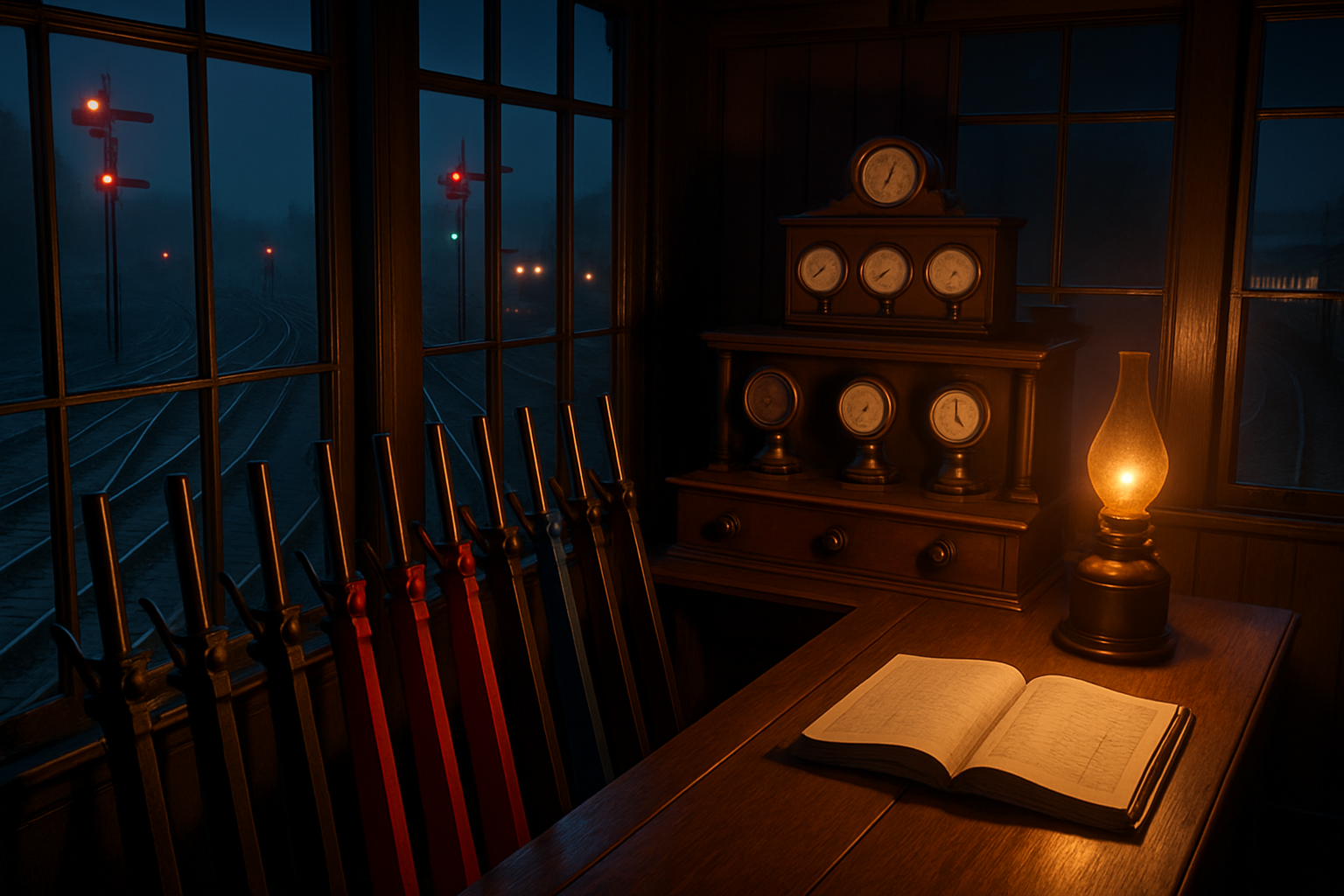
AI concept painting
1 · AI concept
Concept prompt

A Victorian railway signal box interior at night looking out over a busy junction: in the foreground a polished oiled lever frame of tall painted signal levers in red, black and blue standing in a row along the window, a brass block-instrument shelf with dials and a bell above them, an oil lamp throwing warm light across the varnished timber and the signalman's log book; through the tall windows the junction beyond falls away into blue night — converging steel rails catching the light, point blades and switch rodding, semaphore signal posts with red and green spectacle lamps glowing, a distant locomotive's headlamp and lit carriage windows, wet gravel ballast and telegraph poles receding into fog, warm brass and lamp-amber against deep blue night and cold steel, quiet concentrated mood, high-end stylized 3D game render, no text, no watermark, no UI
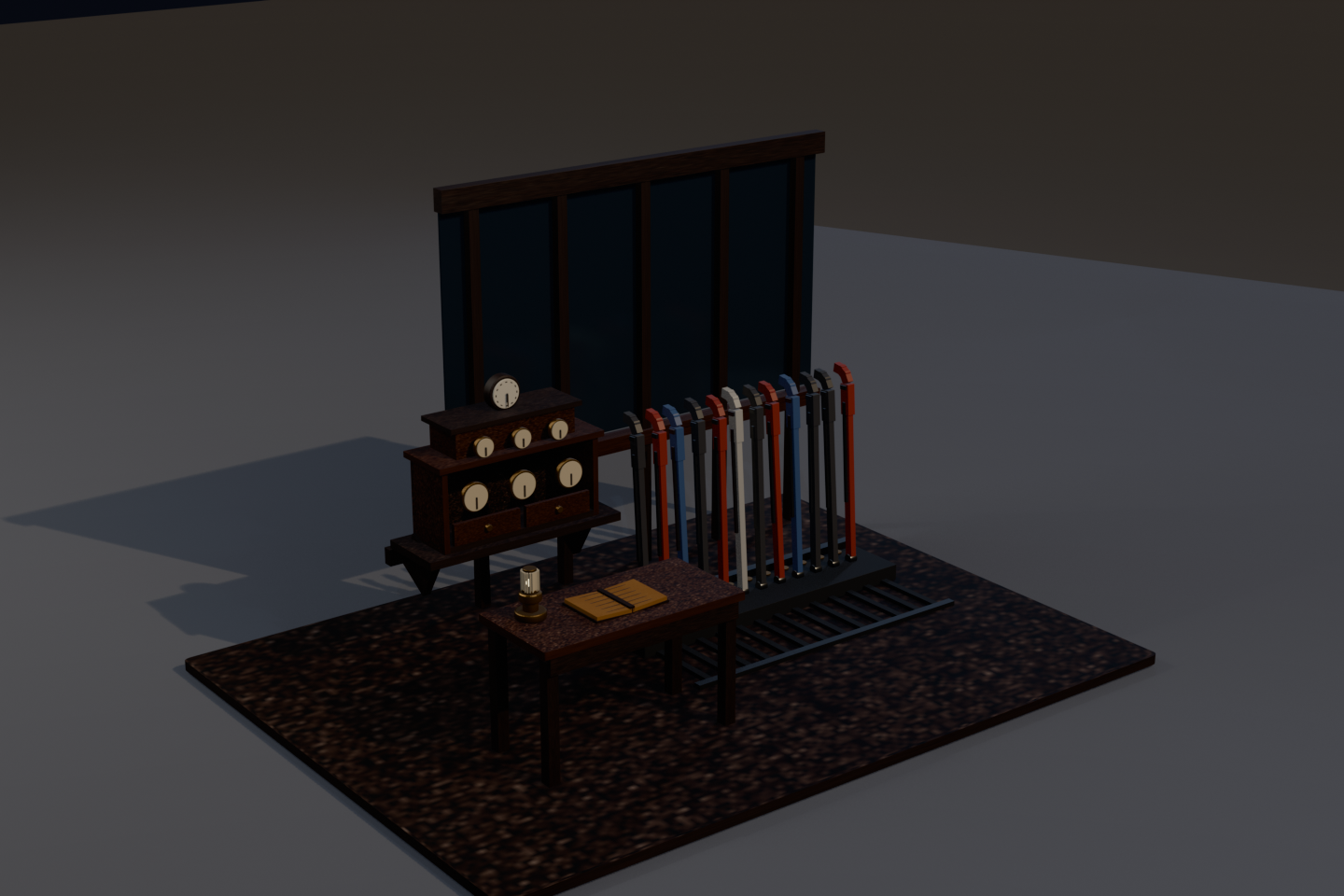
Blender studio render
2 · Blender render (code-modeled)
Space books you on · 1-9 or click pulls a lever · levers 4/7/10 set the roads · lever 2 is the signal · R restarts the shift Open fullscreen ↗
Made by AI, compiled by the real Unity 6 engine. This is a MINI-GAME, so it carries a full loop: book on, work the shift, win or lose it, restart. Four Blender exports build the box — the lever frame, the brass block instruments, the desk with its oil lamp and log book, and a semaphore signal the engine instances out in the yard — and the engine wires twenty-one named pivots out of them so every lever, dial, clock hand, point blade and signal arm moves on its own hinge. The probe was URP's world-space Canvas, which had never been measured in this lab: the proven-safe list of code-built interface parts was entirely screen-space, and world-space is exactly the kind of renderer path that looks correctly wired and silently draws nothing — three previous cycles found precisely that failure in other features. So the piece shipped with a control group beside it from the first line of code: the same train board also renders through the proven render-texture route onto a panel mounted next to the canvas, same size, same data. The answer, visible in the piece itself, is that both read identically — world-space Canvas works here, and the safe list grows. The lever frame is also a direction-encoding interface, so the piece proves its own wiring at boot: for each road it drives the lever the game claims owns it and checks that lever moved, that road armed, and that no other lever did. All sound is sampled - never synthesized.