Pieces
Each card is a piece produced by the loop above — newest first.
Most generated game audio is a loop and some beeps. Every piece here is a score: multi-section themes with fills and B-sections, layers that react to play, and effects built from layered real instruments — playable in the browser, judged until clean.
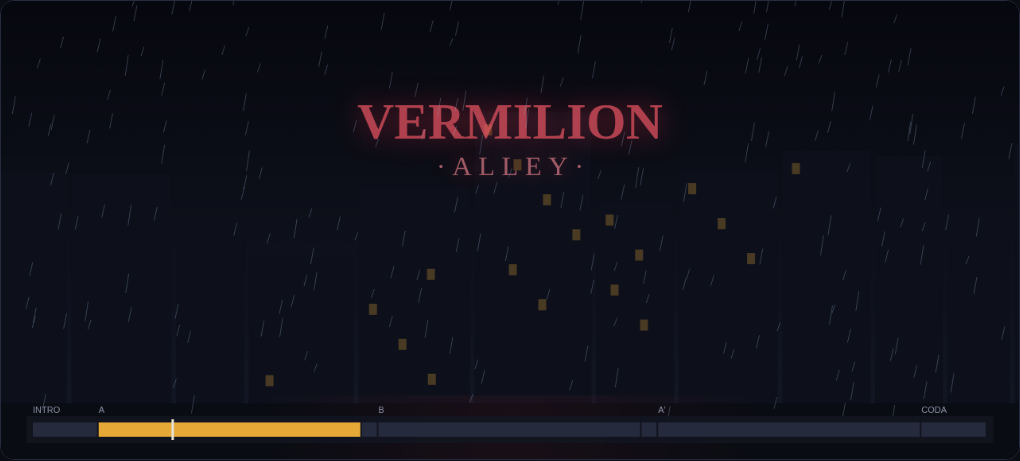
Try the AI Game BuilderA single loop repeating unchanged for a session is a failed cycle by definition. Every score has real musical form — theme, B-section, fills, variation — mapped bar by bar, so ten minutes of play never sounds like one minute repeated ten times.
At least three intensity layers enter and exit musically — bar-aligned, never mid-phrase — as play heats and cools, with ducking under impacts. The gallery piece proves it: drag the intensity slider and hear the arrangement respond.
A pick-up you hear four hundred times deserves more than one marimba note. Every effect is layered from ≥2 real instrument voices with pitch and velocity variation per trigger — the exact class of cheap-SFX defect that once blocked real customer builds.
The platform’s audio verifier — the one that blocks customer builds on composition and SFX-design defects — is self-applied here at its strictest reading, plus numeric checks: section boundaries present, layer counts, spectral variety between sections.
Genre, tempo, mood, instrumentation palette — committed first.
Theme, B-section, fills, variation — from 84 sampled instruments.
State-reactive arrangement; layered, varied SFX.
The platform’s own audio rubric at its strictest, plus numbers.
An interactive player: score, intensity slider, every SFX.
Each card is a piece produced by the loop above — newest first.
Platform decree, born from shipped defects: bare-oscillator audio reads as cheap instantly. Every sound — music and effects — comes from an 84-instrument sampled library of real instruments, in every genre.
The score is arranged in layers tied to game intensity: calm play gets the base arrangement, action brings layers in on the bar, impacts duck the bed. Each gallery piece has an intensity slider so you can hear it respond.
By the same audio verifier that gates customer games — composition form, layering, SFX craft — self-applied at its strictest reading, plus numeric checks on section boundaries and spectral variety. Findings iterate until a full pass is clean.
Yes — every game the builder ships composes its score and sound kit from the same sampled library under the same standards this lab hardens.
The builder composes every game’s score and sound kit from real sampled instruments.
Try the AI Game Builder