Cataract Reach
The complete audio for a hypothetical river-expedition adventure: a keelboat crew paddling up an uncharted highland river. A 66-bar orchestral score in 6/8 — the paddling lilt — with a trumpet-and-horn main theme over open D-major harmony, a lyrical G-major second subject, the theme restated in borrowed F major, and a D-minor rapids set-piece built on hemiola brass — four headway-driven layers, river + forest ambience, and a seven-sound expedition kit. Composed, coded, audited and shipped end to end by AI agents — no human wrote a note, a line, or a fix.
Listen now
Space plays and pauses · the headway slider moves the layers · keys 1–7 fire the kit · ~36 MB of sampled orchestra and river ambience, fetched per instrument after your first click.
The brief is the contract
Committed before a single note was scheduled, with a cross-lab originality scan logged. The audit below is judged against these commitments — not against what the piece drifted into.
Committed identity — BRIEF.md, 2026-08-15
- Game
- River-expedition adventure — paddle the reach, read the water, run the rapids
- Mood
- Open-air heroism; danger arrives as weather, not as a villain
- Key
- D major, Copland-open 4ths and 5ths; B in G; A′ restates the theme in borrowed F; rapids in D minor
- Meter
- 6/8 with the eighth at 176 — the paddling lilt, first compound-meter piece
- Palette
- Strings + pizzicato · trumpet, horns, trombone, tuba · oboe, flute, piccolo · harp · timpani + orchestral percussion; river + forest ambience
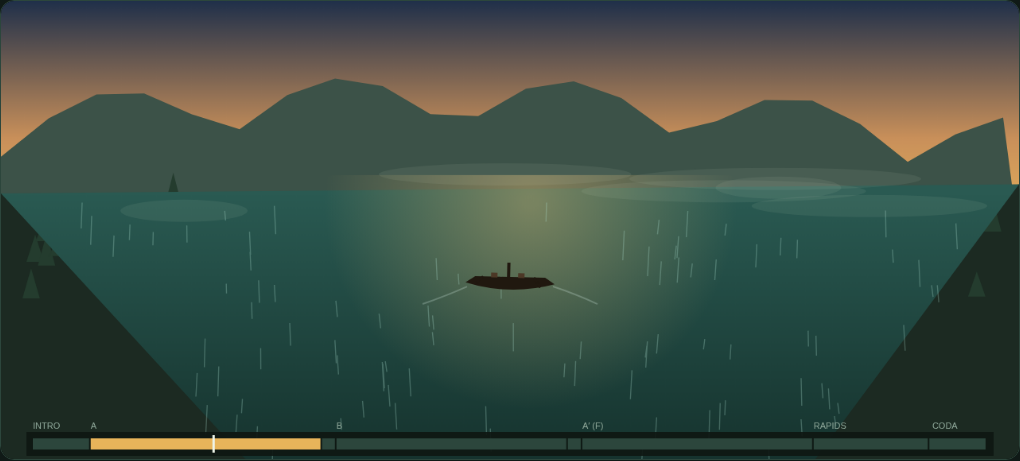
Musical form
| Section | Bars | What changes |
|---|---|---|
| Intro | 4 | String pedal on D builds; the horn sketches the open-fifth call; the pizz current enters at bar 3. |
| A theme | 16 | Trumpet call and french-horn answer in 4-bar phrases over a strings 8th-note ostinato, pizz pulses and timpani — open D-major harmony (D, G/D, A, Bm7, G6/9). |
| Fill | 1 | Timpani strokes and a snare crescendo. |
| B section | 16 | Second subject in G: oboe leads, violin answers in the held-note bars, and the ostinato DROPS to a pizz-and-harp barcarolle sway — a real feel change. |
| Fill | 1 | Harp sweep and a falling flute run. |
| A′ in F | 16 | The theme restated in borrowed F major: horns carry it, the trumpet takes the soaring third phrase and floats a descant over the horn's long notes, trombone/tuba give the low foundation. |
| Rapids | 8 | D-minor set-piece: string tremolo waves, timpani rolls, gran cassa, snare pressure, and brass accents alternating 3+3 and 2+2+2 hemiola groupings; the trumpet shouts the theme's cell over the water. |
| Coda | 4 | The call in augmentation over tutti strings, a glockenspiel glint, D-add9 hang — then the loop returns to A. Every pass re-rolls. |
State layers — proven by the slider
| Layer | Enters | Content |
|---|---|---|
| L0 bed | always | String sustains, contrabass, pizz pulses, timpani; the ostinato/barcarolle per section. |
| L1 lead | headway > 15% | The melody voices — trumpet/horn, oboe+violin, or the F-major tutti per section. |
| L2 current | headway > 40% | Violin ostinato doubling, flute runs, piccolo glints on phrase starts. |
| L3 drive | headway > 72% | Trombone/horn accent pads, snare pressure, crash colour on phrase starts. |
- Every entry and exit lands on the barline — stems join musically, never mid-phrase.
- Hull impacts and the rapids alarm duck the music bus and release automatically.
- Ambience intensity (ripple detail, bird activity) follows the same headway parameter.
Sound kit — layered, varied, tuned to the key
| Effect | Voices | Design |
|---|---|---|
| Paddle stroke (most frequent) | 3 × 4 round-robin bodies | Low pizz/contrabass pluck bodies with tom and harp shadows; a 4-note low D-major pool that never repeats a pitch, ±45-cent drift. |
| Oar creak | 3 | Low woodblock + claves + a short low cello grain, three pitch bodies. |
| Supply pickup | 4 | Glockenspiel lift + harp touch + a flute grace note, three in-key variants. |
| Chart marker | 3 | High pizz + glockenspiel + side-stick tick, three pitches. |
| Hull scrape | 3 | Contrabass low + floor tom + a short tremolo swell; ducks the music 35%. |
| Rapids alarm | 9 | D-minor brass stab (trombone/horn/trumpet) + five-hit timpani roll + china; ducks the music 50%. |
| Portage fanfare (rare ceremony) | 7 | Three-note trumpet fanfare (3 variants) with horn under, glockenspiel over and a snare flam. |
Audited until clean
- 100% sampled voices — oscillator spy across playback and SFX confirms every audible voice is an AudioBufferSourceNode; ambience stems prefetched so the procedural fallback never fires.
- Form verified numerically — bar-aligned captures: lead-voice sets, ostinato-vs-barcarolle kinds, borrowed F/B♭ bass roots in A′, tremolo/roll kinds and 2-vs-3 hemiola accent counts in the rapids, all from the performed event stream; 6/8 bar period verified from event timestamps; spectra as corroboration.
- Layers verified — headway 0 vs 1: bed-only when drifting, runs/stabs/snare join under way, all entries bar-aligned.
- SFX variation verified — 20 triggers per effect: every trigger ≥2 voices, pools and bodies never repeat, onsets spectrally rich.
- Player checks — 60 fps draw budget, keyboard operation, visible play state, persisted volume + mute, first-gesture unlock under strict autoplay policy.
- Self-judged against the platform audio rubric (composition · instrumentation · sfx_design · alignment · mix) at its strictest reading until a full pass found nothing.
The instructive failure: the first ambience-balance number was “93 dB under,” which would mean the bed was inaudible — it wasn't. Subtracting captures taken over different bars of a non-stationary score is meaningless. The method was rebuilt to pin the same bars for both captures and to fail in both directions. The artifact and the fix shipped to guidance together.
The measured numbers
| Measurement | Value | Method / conditions |
|---|---|---|
| Numeric audit | 28/28 checks, clean twice consecutively | Playwright + PCM tap |
| Fix rounds to clean | 2 | composer syntax slips caught in self-review before running; balance method rebuilt (below) |
| Ambience bed, first method | read “93 dB under” — a measurement artifact, not a mix truth | on/off RMS subtraction across different bars of a non-stationary score goes negative |
| Ambience bed, rebuilt method | 5.9 dB under | same-bars capture, deterministic seek, bounded both ways 3–30 dB — now the platform rule |
| A′ borrowed-key restatement | chroma 0.814 for D-vs-F — the strongest chroma signal of any piece | band cosine saturated at 0.9958 and was set aside for this regime |
| Rapids hemiola | tuba accent counts alternate exactly {2,3} — 3+3 vs 2+2+2 | event stream |
| Bar period | 2.045 s measured — exactly 6/8 at ♪=176 | median inter-bar delta of event timestamps |
| Oscillators created | 0 | createOscillator spy |
| SFX variation | 19–20/20 unique signatures per 20 triggers | 7 effects, 3–9 voices |
| Visualizer draw cost | 0.42 ms/frame | pre-rendered sprites from day one — piece 03's lesson applied |
Engine features, earned
Bar-lookahead scheduler
Compound meter throughout: 66 bars of 6/8 with fills and a set-piece episode, all barline-exact at 2.045 s a bar.
RTPC layer binding
Headway adds violin doubling, wind runs and brass weight; verified by the mid-bar flip test.
Hemiola accent engine
The rapids alternate 3+3 and 2+2+2 accent groupings in the brass — scheduled, logged, counted.
Borrowed-key restatement
A′ carries the theme in F with horns leading and a trumpet descant — the audit separates it by chroma, not hand-waving.
Bus ducking
The rapids alarm and portage fanfare duck the orchestra and release on time.
Layered ambience stems
River + forest stems, prefetched, following headway.