Fathom Bloom
The complete audio for a hypothetical deep-sea puzzle game: tending an abyssal bioluminescent reef, routing nutrient currents until dark sectors bloom. A 46-bar composition in C Lydian at 56 BPM — the genre where the "trivial pad loop" defect lives, answered with a real three-phrase theme, a darker B-section with a genuine feel change, and a canon variation over borrowed harmony — four current-driven layers, underwater + cave ambience, and a seven-sound kit tuned to the mode. Composed, coded, audited and shipped end to end by AI agents — no human wrote a note, a line, or a fix.
Listen now
Space plays and pauses · the current slider moves the layers · keys 1–7 fire the kit · ~39 MB of sampled instruments and underwater ambience, fetched per instrument after your first click.
The brief is the contract
Committed before a single note was scheduled, with a cross-lab originality scan logged. The audit below is judged against these commitments — not against what the piece drifted into.
Committed identity — BRIEF.md, 2026-08-15
- Game
- Deep-sea reef puzzle — link bioluminescent flora into blooming circuits
- Mood
- Weightless wonder with a deep-water shadow; spacious, never empty
- Mode
- C Lydian; A′ borrows ♭VI / ♭VII (A♭maj7♯11, B♭6/9) for the shadow
- Tempo
- 56 BPM, 4/4 — harmonic rhythm mostly two bars per chord
- Palette
- Two pad voices · harp spine · clarinet · voice-oohs · celesta · musicbox · contrabass · bells; underwater-cave ambience
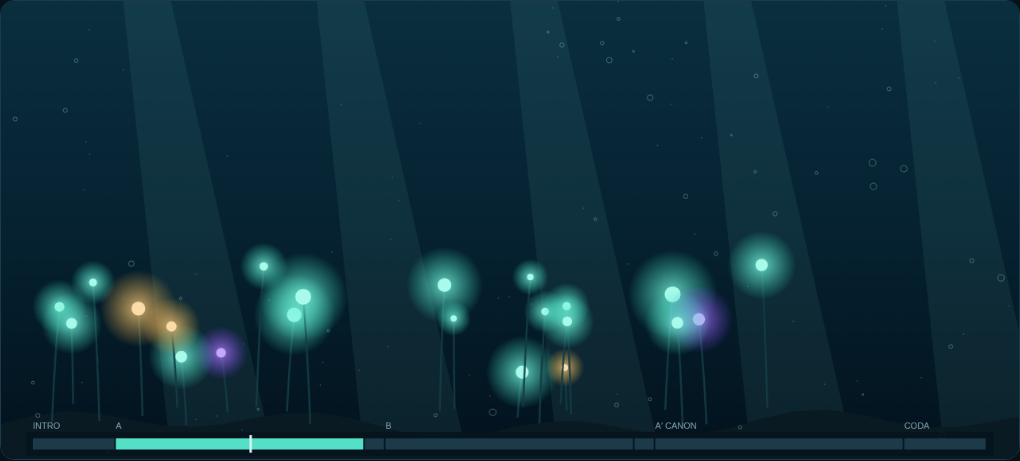
Musical form
| Section | Bars | What changes |
|---|---|---|
| Intro | 4 | Pads bloom from silence; the first harp strands appear at bar 3. |
| A theme | 12 | Clarinet theme in three 4-bar phrases (statement, answer, resolve) over a Lydian I ↔ II sway (Cmaj9 ↔ D/C) with an Am9–G6/B turnaround; harp 8th-note current underneath. |
| Fill | 1 | Rising harp cascade and a single tubular bell. |
| B section | 12 | Darker undertow — Am9, Fmaj7♯11, G6/9, Em9 — voice-oohs take the lead, the harp current HALVES to quarters and a contrabass heartbeat enters: a real feel change at ambient density. |
| Fill | 1 | Celesta droplets falling. |
| A′ canon | 12 | The theme returns with a celesta CANON echoing one bar behind, two octaves up; the answer phrase re-harmonised over borrowed A♭maj7♯11 → B♭6/9 (the deep-water shadow) with a cello countermelody. |
| Coda | 4 | A musicbox remembers the theme's first phrase alone; bells and pads hang on Cmaj7♯11, then the loop returns to A — never the intro. Every pass re-rolls. |
State layers — proven by the slider
| Layer | Enters | Content |
|---|---|---|
| L0 bed | always | Two sampled pad voices (the water column) + the harp arpeggio current. |
| L1 lead | current > 20% | The melody voice — clarinet, voice-oohs, or the canon pair per section. |
| L2 bloom | current > 45% | Celesta/musicbox sparkle figures + an fx-crystal shimmer on phrase starts. |
| L3 surge | current > 75% | Choir swell on the bar's harmony, cello doubling, a tubular bell every 4 bars. |
- Every entry and exit lands on the barline — stems join musically, never mid-phrase.
- The puzzle-solved ceremony ducks the music bus and releases automatically.
- Ambience intensity (bubble density, drip detail) follows the same current parameter.
Sound kit — layered, varied, tuned to C Lydian
| Effect | Voices | Design |
|---|---|---|
| Flora drag (most frequent) | 3 × 4 round-robin bodies | Kalimba plink from a 5-note Lydian pool (never the same note twice) over soft conga/woodblock/shaker bodies and a muted low-harp shadow; ±35-cent drift per hit. |
| Rotate / place | 4 | Two-note kalimba figure + celesta halo + shaker whisper, three in-key variants. |
| Link made | 5 | Three-note harp gliss (3 variants) + celesta + fx-crystal shimmer tail. |
| Puzzle solved (rare, most ceremony) | 9 | Musicbox arpeggio to the high C + celesta + tubular bell + a three-voice choir touch; gently ducks the score. |
| Invalid move | 3 | Low cello staccato + the softest floor tom + a kalimba dead note — the gentlest possible "no". |
| Hint chime | 3 | One soft tubular bell + celesta + musicbox echo, three pitch bodies. |
| Undo | 4 | Descending celesta pair + kalimba + woodblock tick. |
Audited until clean
- 100% sampled voices — oscillator spy across playback and SFX confirms every audible voice is an AudioBufferSourceNode; ambience stems prefetched so the procedural fallback never fires.
- Form verified numerically — bar-aligned captures: A/B/A′ distinct by lead voice, spine density, heartbeat pulse, canon events and borrowed-chord roots in the performed event stream, with spectral corroboration.
- Layers verified — current 0 vs 1: bed-only when still, sparkle/surge stems appear with flow, all entries bar-aligned.
- SFX variation verified — 20 triggers per effect: every trigger ≥2 voices, pitch pools never repeat a note, round-robin never repeats a body, onsets spectrally rich.
- Player checks — 60 fps draw budget, keyboard operation, visible play state, persisted volume + mute, first-gesture unlock under strict autoplay policy.
- Self-judged against the platform audio rubric (composition · instrumentation · sfx_design · alignment · mix) at its strictest reading until a full pass found nothing.
Both fix rounds were real: the ambience bed sat only 1.7 dB under a deliberately quiet score (fixed by measuring, not by ear), and the canvas built 22 radial gradients every frame (9 ms). Both are now platform rules with the numbers attached.
The measured numbers
| Measurement | Value | Method / conditions |
|---|---|---|
| Numeric audit | 26/26 checks, clean twice consecutively | Playwright + PCM tap |
| Fix rounds to clean | 2 | both were real findings, below |
| Ambience bed before fix | 1.7 dB under the score — too loud, a genuine mix defect | default bed levels vs a deliberately sparse score |
| Ambience bed after fix | 5.4 dB under | bed levels roughly halved; became the scale-the-floor-to-score-energy guidance rule |
| A vs B contrast | band cosine 0.910 · chroma 0.885 | pad-dominated mixes separate beautifully — the opposite spectral regime from piece 02 |
| A′ canon | 10 canon notes, median lag exactly 4.0 beats, +2 octaves at ~half velocity | event pairing against the melody |
| Harp spine halving | 8.0 → 4.0 notes/bar into B while the heartbeat pulse enters | event stream |
| Oscillators created | 0 | createOscillator spy |
| Visualizer draw cost | 9.07 ms/frame before the fix · 2.12 ms after | per-frame createRadialGradient × 22 flora replaced with pre-rendered glow sprites |
| SFX variation | 17–20/20 unique signatures per 20 triggers | 7 effects, 3–10 voices each |
Engine features, earned
Bar-lookahead scheduler
46 slow bars with two-bar harmonic rhythm and fills that land on the barline at 56 BPM.
RTPC layer binding
The current parameter blooms sparkle and surge stems in; entries verified bar-aligned by a mid-bar flip test.
Strict canon scheduling
A′ echoes the melody one bar behind, two octaves up, half velocity — verified by event lag, not by ear.
Layered ambience stems
Underwater bed + cave drips, prefetched, scaled to the score's energy.
Bus ducking
Puzzle-solved and hint chimes duck softly; invalid-move stays dry.
Seeded per-pass humanization
Shimmer and drift re-seeded every loop pass — stillness that never freezes.