From contract to engine
Click a panel to open it full size.

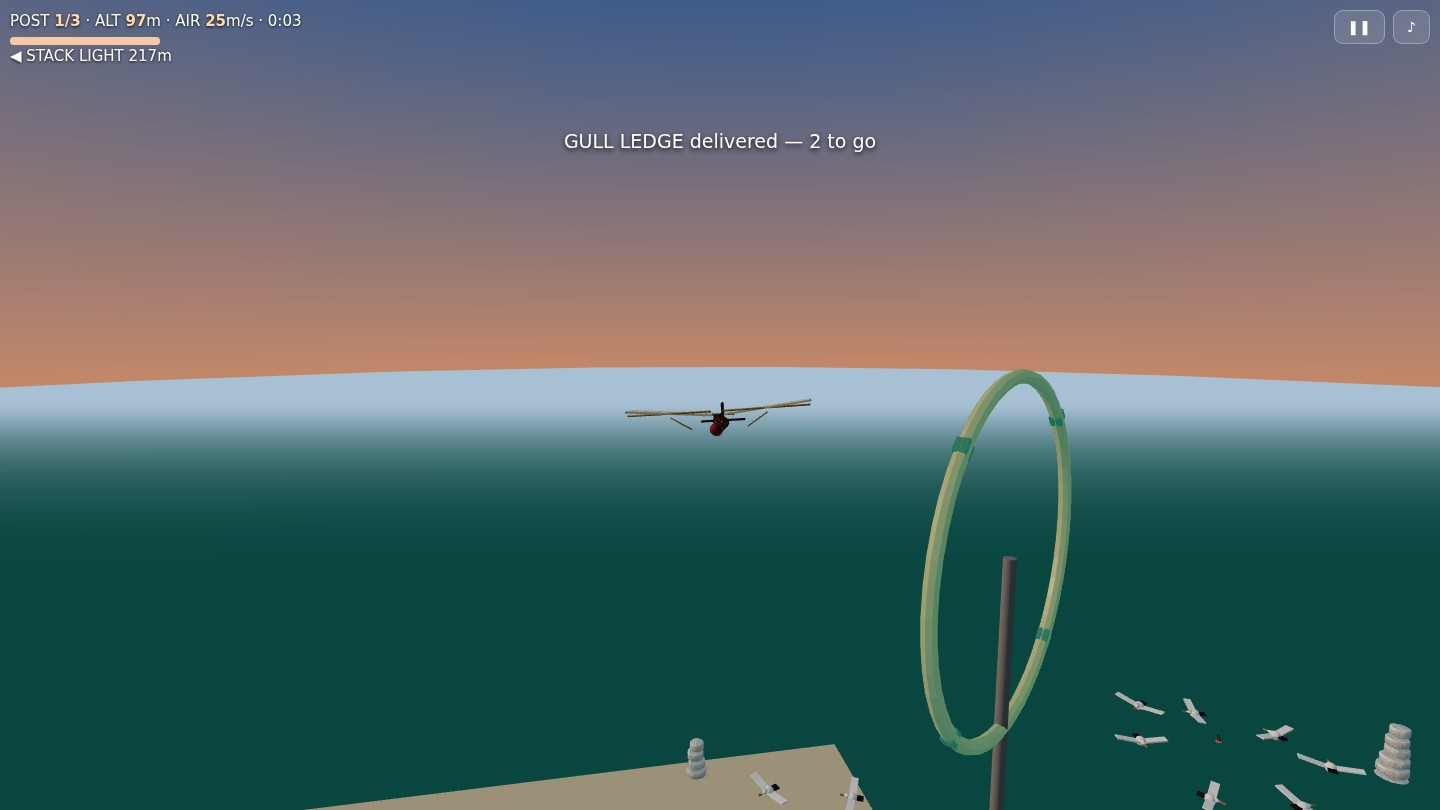
An engineless mail sailplane modeled in code — a brass tube frame under doped canvas, an oxblood fuselage pod, gentle dihedral and a wire-braced tail — with a high-poly source carrying rib tapes, wing lacing and a cockpit gauge baked down onto the 2,192-triangle hull that ships. It was built from a written contract rather than a painted turnaround, because the image generator was out of credit on the morning it was authored, and that changed how the asset had to be specified.
saltwind_glider.glb · 0.45 MB · glTF 2.0 — modeled in code, exported from headless Blender
Click a panel to open it full size.
Every other asset in this studio is audited against a painted sheet: you look at the
render and the concept side by side and you can see the difference. This one had no sheet.
The seven panel prompts were composed before generation was attempted and kept
verbatim as the binding contract, and the palette — normally pixel-sampled from the
painting — was committed instead as exact sRGB hex: canvas #ddd2b8,
brass #b08d4a, oxblood #8e3b34, timber #6b5844.
That makes colour drift impossible to argue about and proportion impossible to check,
so the shape was pinned instead to numbers the contract could carry: a 14 m span,
a 17:1 design glide, dihedral you can read from head on.
The brass fittings baked black on the first attempt — the same fault the studio hit in the previous cycle. Blender’s DIFFUSE bake of a metallic material has no diffuse component to capture, so it writes darkness. The fittings ship as authored brass with the bake confined to the canvas and timber, which is where the interesting detail was anyway.
This asset was built for Saltwind Post, a three.js Lab piece about flying an engineless mail run along a chalk sea-cliff. It was modeled entirely in code (Blender’s Python API) by an AI agent, rendered by headless Blender, and audited before export — the pipeline every Blender Studio asset goes through.