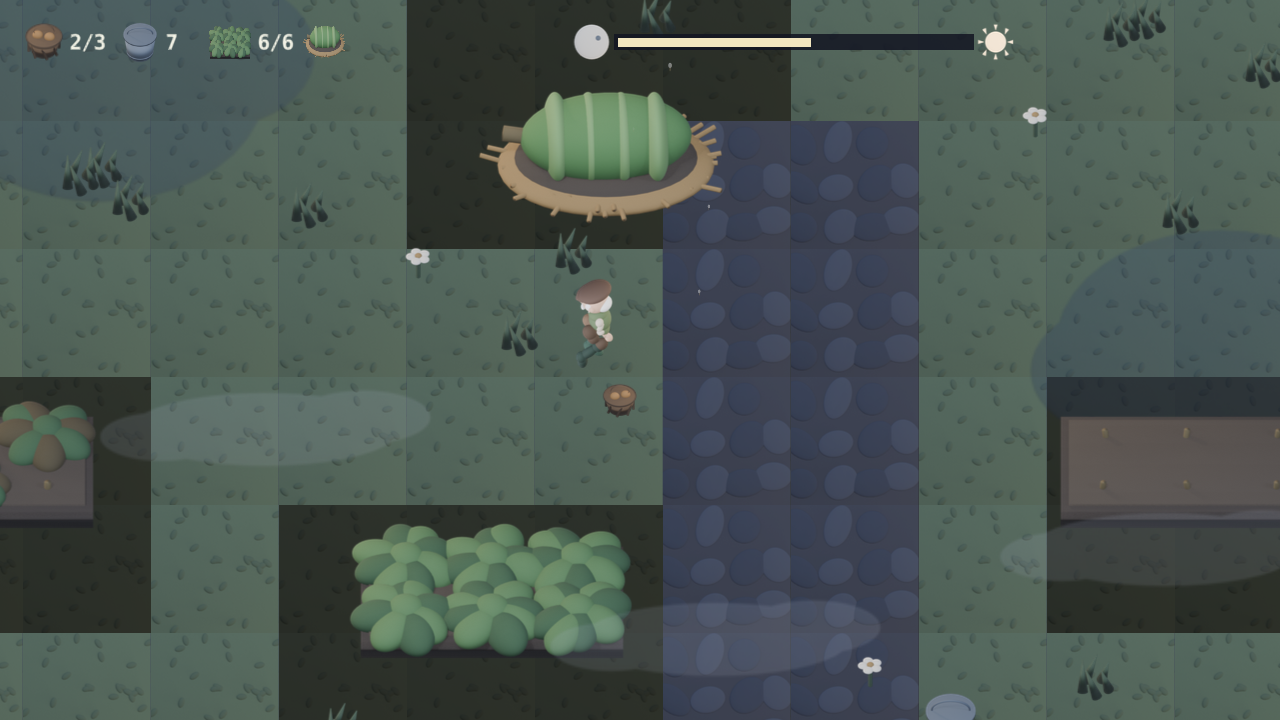
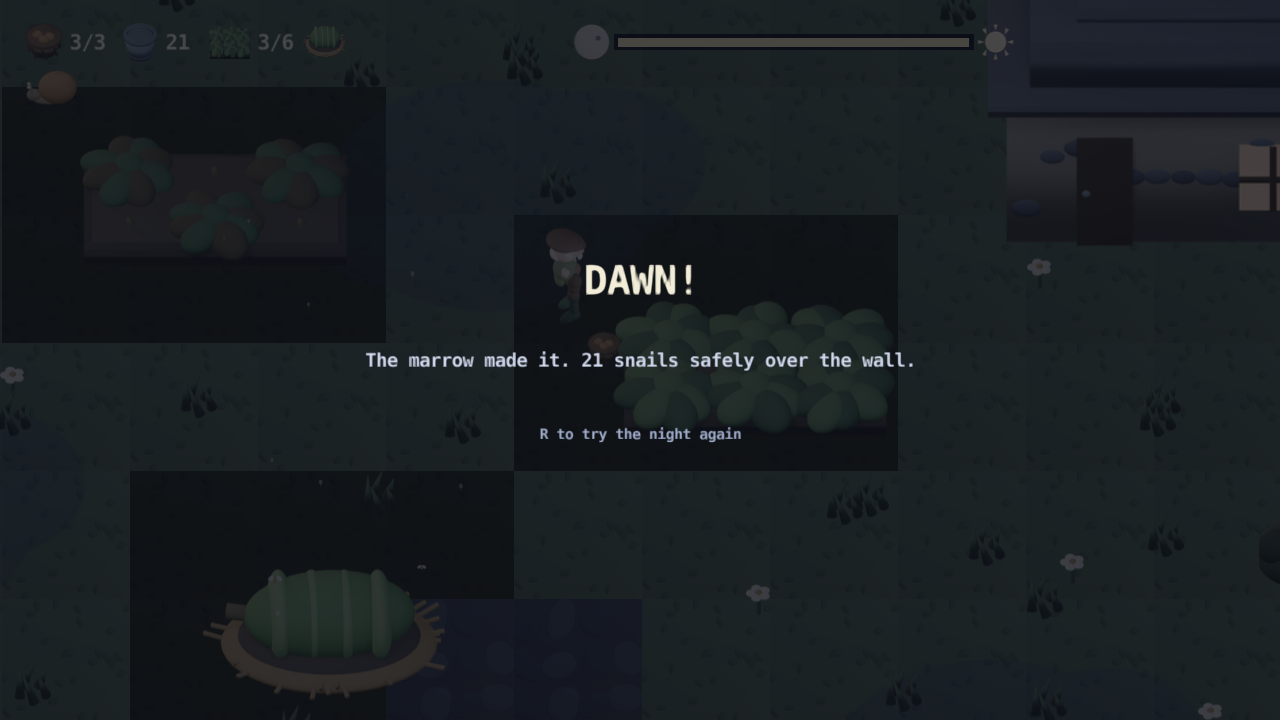
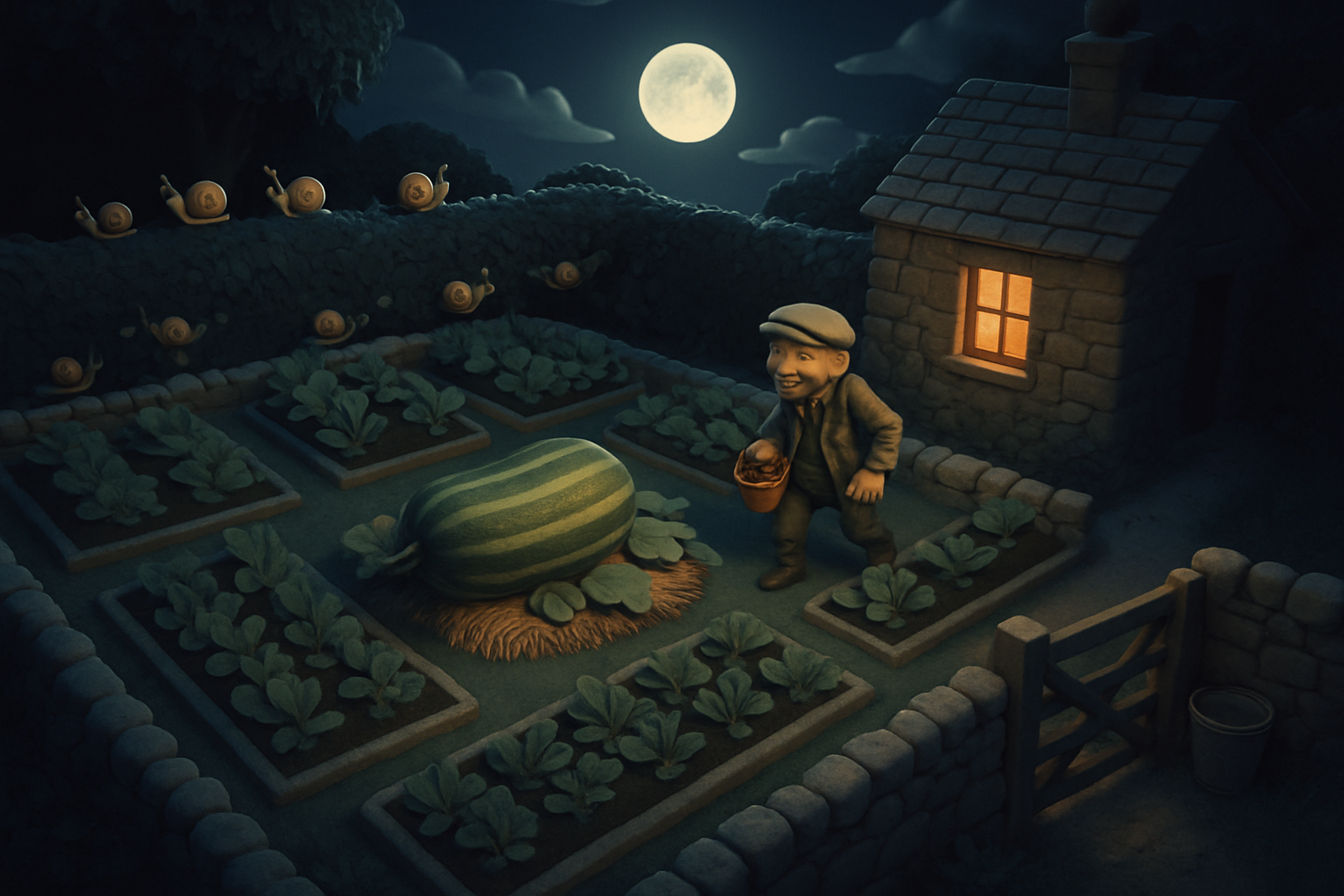
The village show is tomorrow, the prize marrow sleeps on its straw bed — and the snails came tonight. Ferry them to the snail pail before they reach the vegetable beds, and hold the garden until dawn: a complete top-down defense arcade authored end-to-end by AI agents in the real Defold engine, playing in seconds on a phone connection.
Stick / WASD moves · SPACE or the button picks up & drops · ~2.4 MB over the wire
The piece was concepted first: a key-art sheet, a gardener turnaround and a callout board fixed the palette — deep indigo night, moonlit sage, ochre snail shells, one warm amber window. Every named element in the sheets was then authored as a real asset, and the live build is audited against them.

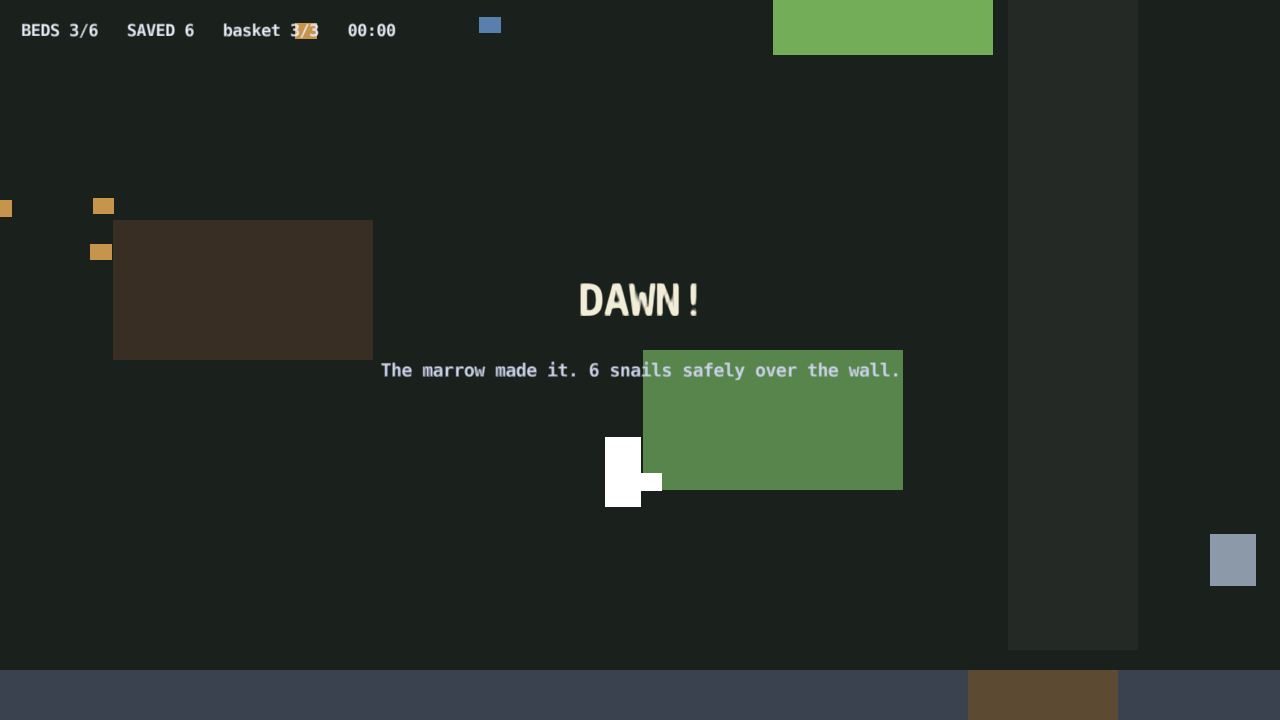
The whole night ran and was defended as gray boxes before any art existed. An automated defender drives every build through the full 240-second night — picking snails, ferrying them to the pail, triaging the marrow — and the blockout rounds caught a real AI defect: snails oscillating in concave corners between beds, fixed with deterministic corner-waypoint routing.


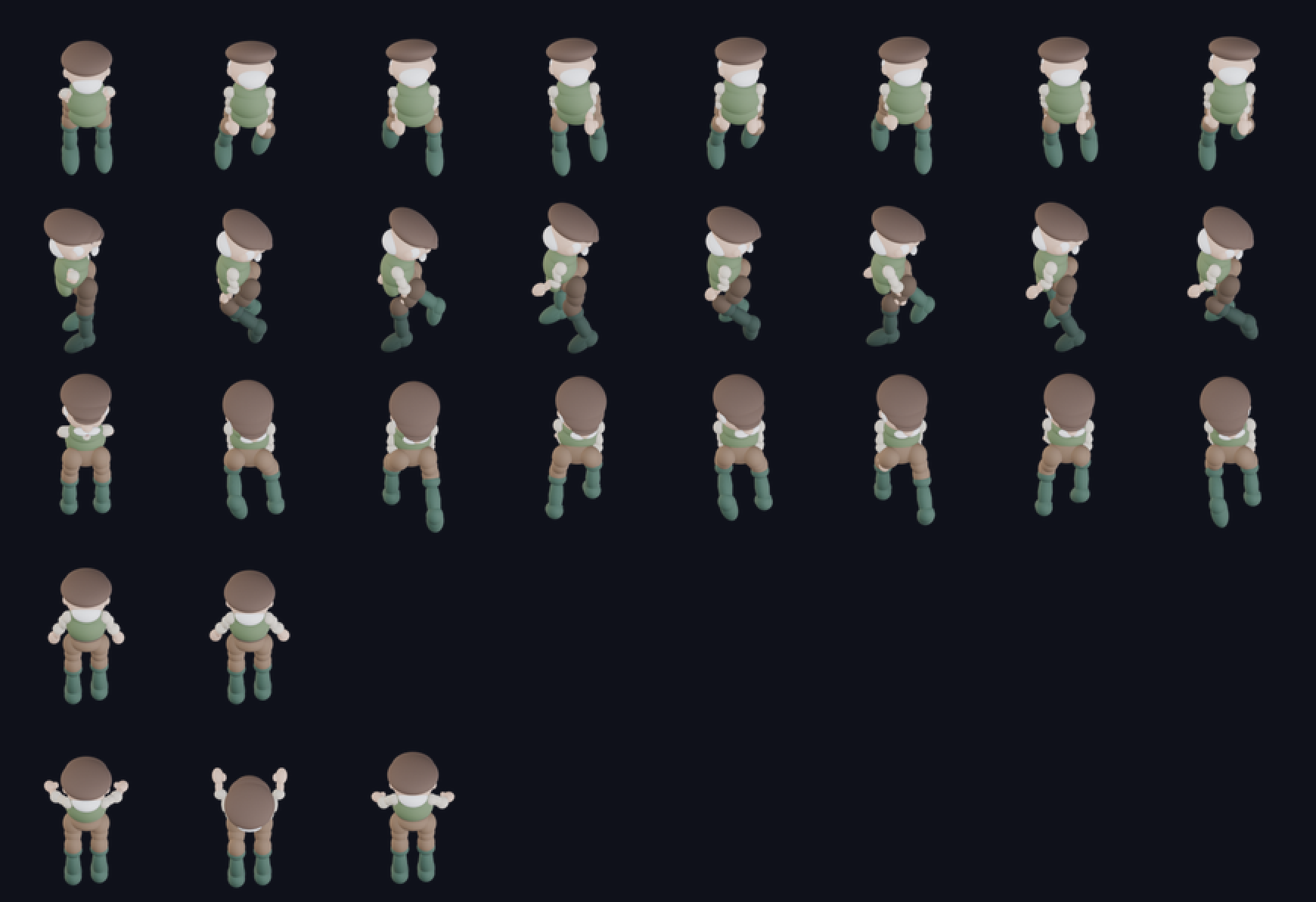
The gardener is a rigged Blender character whose three walking rows come from a retargeted CMU motion-capture walk, rendered from one elevated camera with the character turned per facing. The stoop was probed numerically across two mocap action sets — the best window turned out to be a twisted action fragment, so the pick animation is an authored three-frame stoop, recorded as the fallback. Snails, beds, the marrow, walls, hedges, cottage and ground tiles are all Blender renders packed into Defold atlases, placed by their measured painted-base metrics.
This lab exists to prove a real-engine game can be playing before a phone user loses interest. Every payload ships pre-compressed and inflates in the browser, so any static host serves it optimally. Measured first-playable times, Playwright CDP network throttling, software rendering (a real GPU boots roughly 0.6–1 s faster):
| Connection profile | Throughput / RTT | First playable frame |
|---|---|---|
| Wi-Fi / 4G | 10 Mbps · 60 ms | 2.5–2.6 s |
| Fast 3G (HSPA+ class) | 6 Mbps · 150 ms | 3.95–4.08 s |
| Chrome DevTools “Fast 3G” preset | 1.44 Mbps · 562 ms | 15.3 s |
Total transfer 2.38 MB (engine 976 KB + game data ~1.4 MB, gzip + RDO-basis textures). Bundle 4.17 MB raw. The automated defender wins most nights and honestly loses some — the shipped balance is meant to bite.
Mocap walk rows in three facings, snail flipbooks in three breeds, bed and marrow damage states — all Blender-rendered, basis-compressed.
Grass, stone path and soil painted as a generated tilemap — with the hard-won pad slot that keeps Defold's 0-based cell indexing honest.
Waves of snails, every wall segment, hedge, tuft and flower spawn from factories placed by measured art metrics.
Moths at the lit window and the marrow, drifting night seeds, and a soft pick-up puff — hand-written particlefx.
Physical-pixel HUD with a moon-to-dawn meter, virtual stick and pick button — one layout from desktop to phone portrait.
Snails report bites, beds change state, the basket child GO mirrors with the facing — every system talks via msg.post.