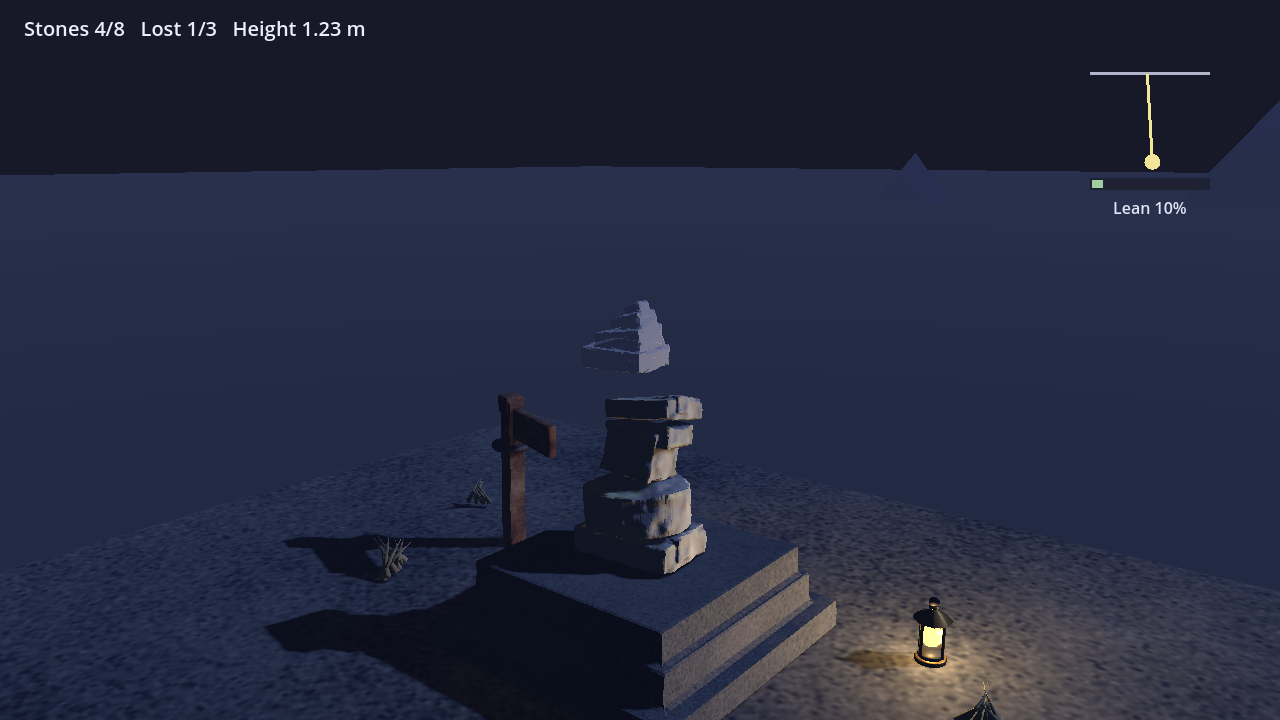
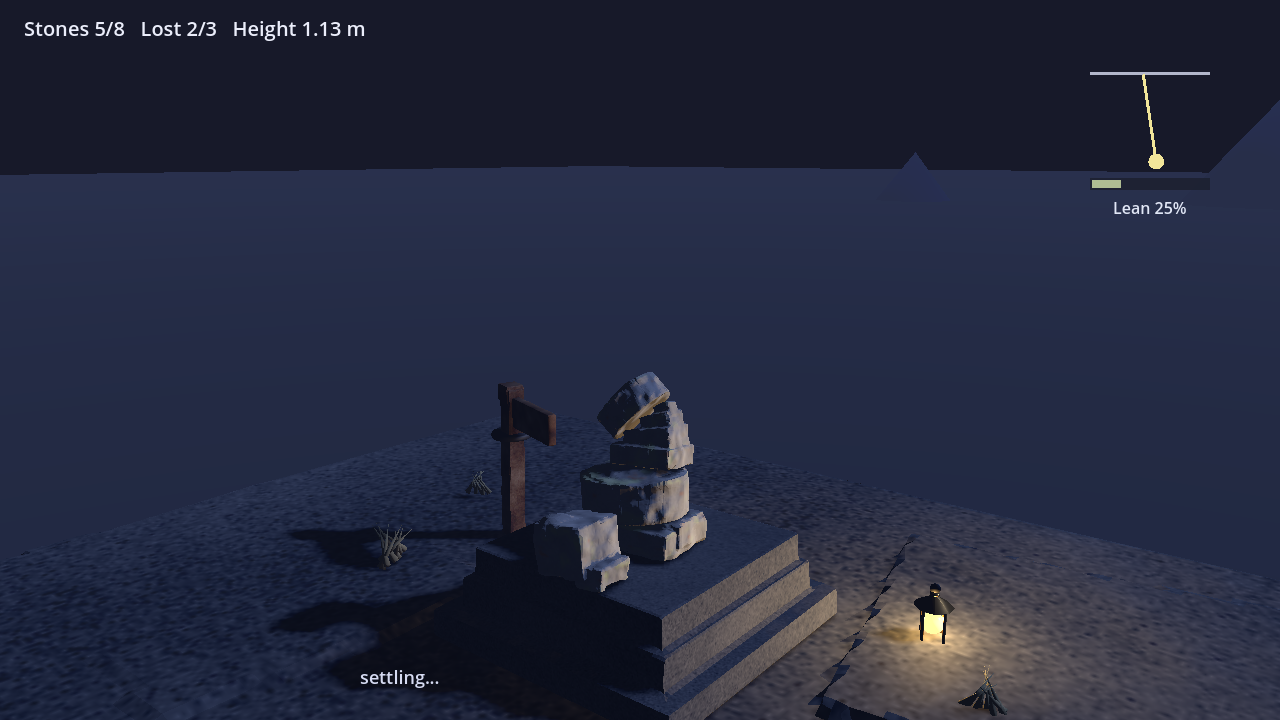
On a mountain pass at dusk you stack a cairn tall enough to mark the path. Nothing about the stack is faked: every stone is a Blender-sculpted mesh whose own convex hull is its collider, and the cairn stands or falls out of contact friction, mass and inertia. Every third stone the wind rises — and a wide flat slab shrugs it off where a tall pillar will not.
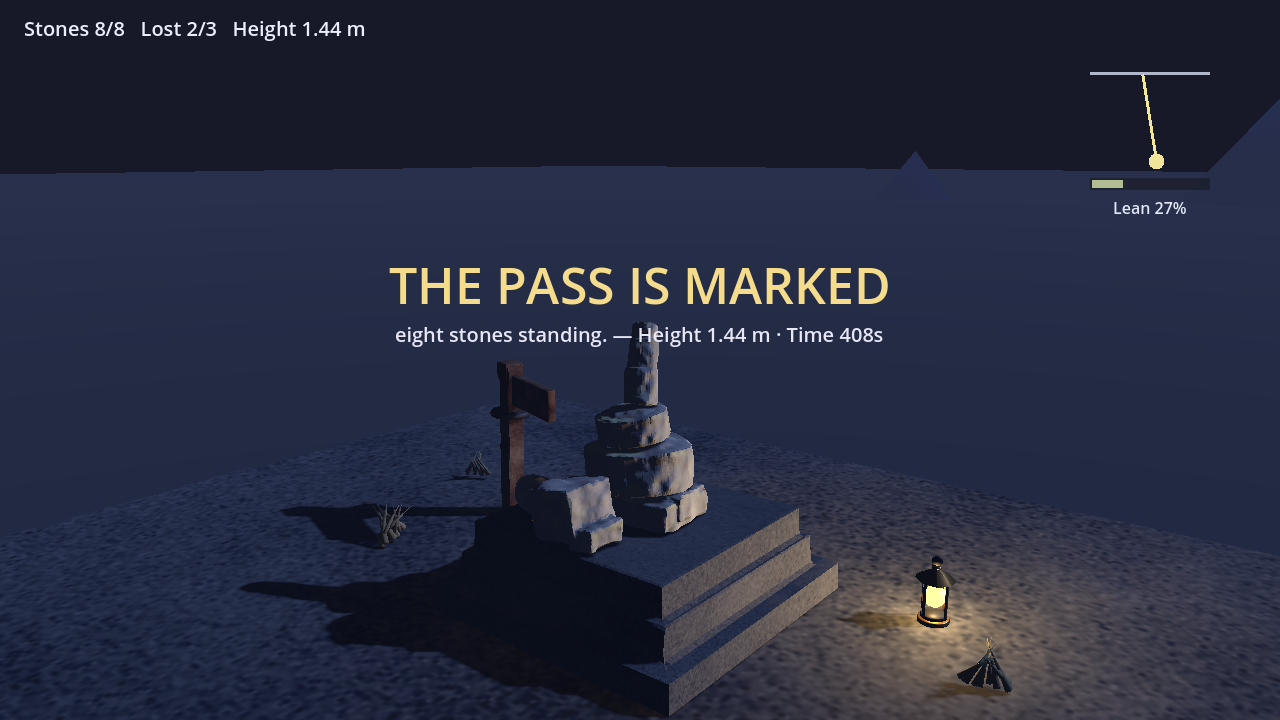
Arrows / WASD to slide the stone over the cairn · Q / E to turn it · SPACE to let it down · P pause · M reduced motion. Eight stones standing; three lost and the light goes.
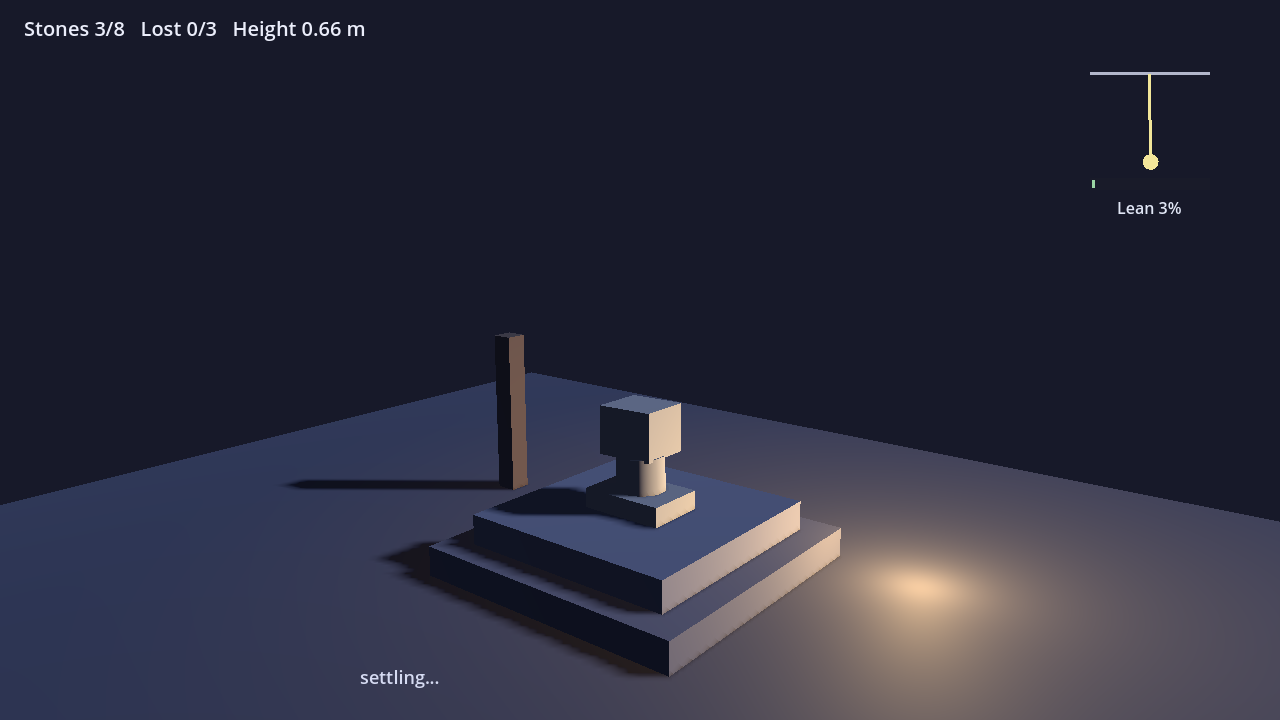
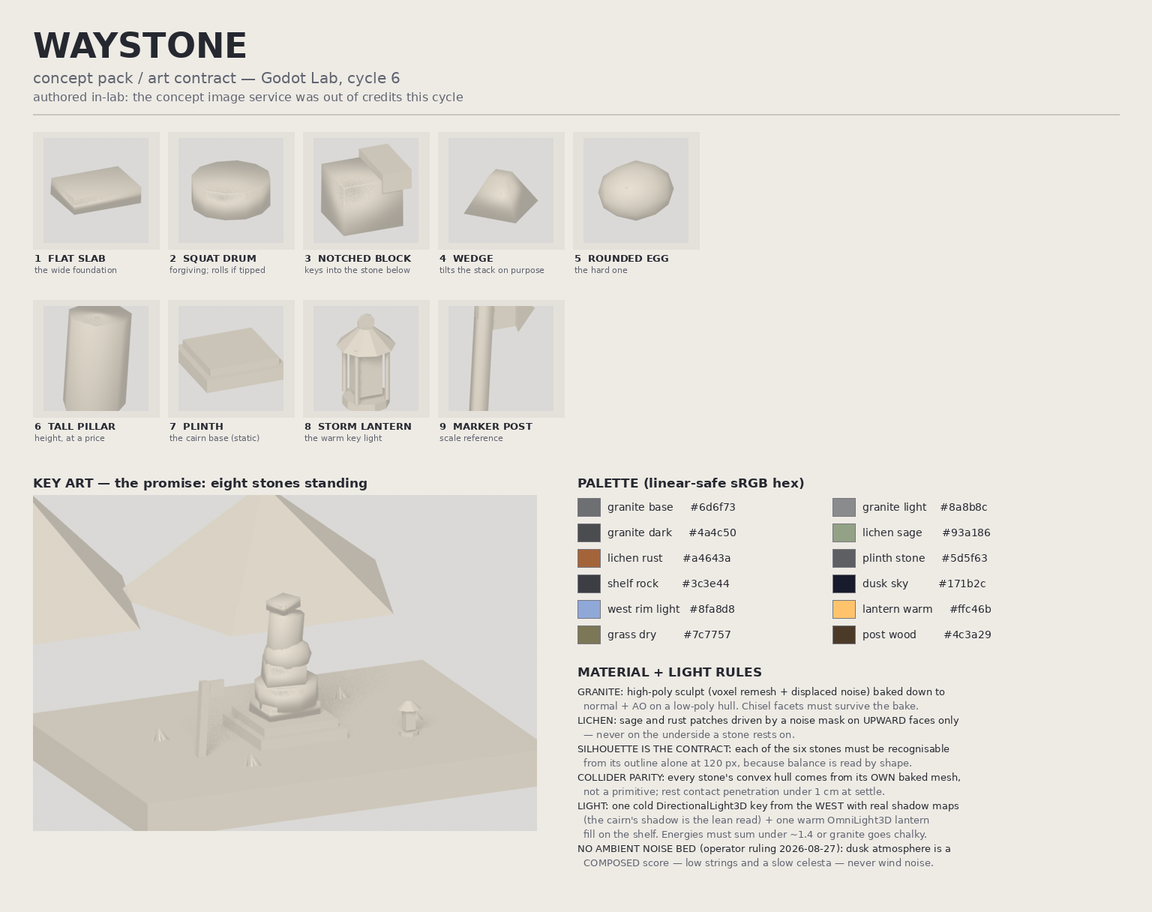
The platform's concept-image service was out of credits on the day this piece was built, so the concept pack was authored in the lab instead: clay maquettes of every silhouette the piece promises, rendered before any final art existed, beside a palette with hex values and the material and lighting rules the art phase had to satisfy. It is still a contract — and it is the one the finished stones were audited against, silhouette by silhouette.

The whole loop ran as primitives first: the hoist, the drop, the settle test, the
wind, the lost-stone rule, the restart. Round 2 caught a real bug the screenshots could not —
the gust fired on a placed % 3 test, and because a gust does not place a stone, the
turn loop re-triggered the same gust forever. It also showed the hoist hovering off the top of the
frame and the camera sitting too low. All three were fixed before a single stone was sculpted.


Each waystone is fused from overlapping primitives, voxel-remeshed, then displaced with two layers of noise and planar-decimated so the surface breaks into chiselled facets instead of melting into a blob. That high-poly sculpt is baked down to a low-poly hull — normal, ambient occlusion and base colour — with lichen driven by a noise mask that is gated on the surface normal, so sage and rust grow on the upward faces and never on the face a stone rests on.
A sculpted stone with a box collider is a defect class, not a shortcut: the stack
would balance on geometry the player cannot see. Here every stone's ConvexPolygonShape3D
is generated from its own baked mesh at load, and the engine's stack maths — the height read, the
hoist's hover point, the centre-of-mass lean — all use the measured half-extents written out
by the Blender build, not numbers typed into the game.


The platform banned looping ambient noise beds the day this piece was built, which is an awkward ruling for a game whose antagonist is the weather. So the wind here is never a recording: the gust is composed — a tremolo-string swell that resolves into a timpani and horn hit — and it is shown, in grass and grit torn sideways and a direction arrow in the HUD. The dusk atmosphere is a slow contrabass and viola drone under a harp figure. Every other sound is an event the player just caused.
Audited with Playwright on this host's software renderer — no GPU, and a machine running four other labs' Blender jobs at the time. The frame rate below is the floor.
| Measurement | Value |
|---|---|
| Export payload (pck) | 6.41 MB |
| Engine runtime (wasm, fixed) | 33.7 MB |
| Authored art in the payload | 11.48 MB |
| Audio stems | 0.45 MB |
| Blockout rounds | 6 - r2 caught a wind gust that re-fired forever; r5 played 104 complete nights in 50 minutes and collapsed at stone 5 every one |
| Art audit rounds | 9 - r8 clean, r9 confirming |
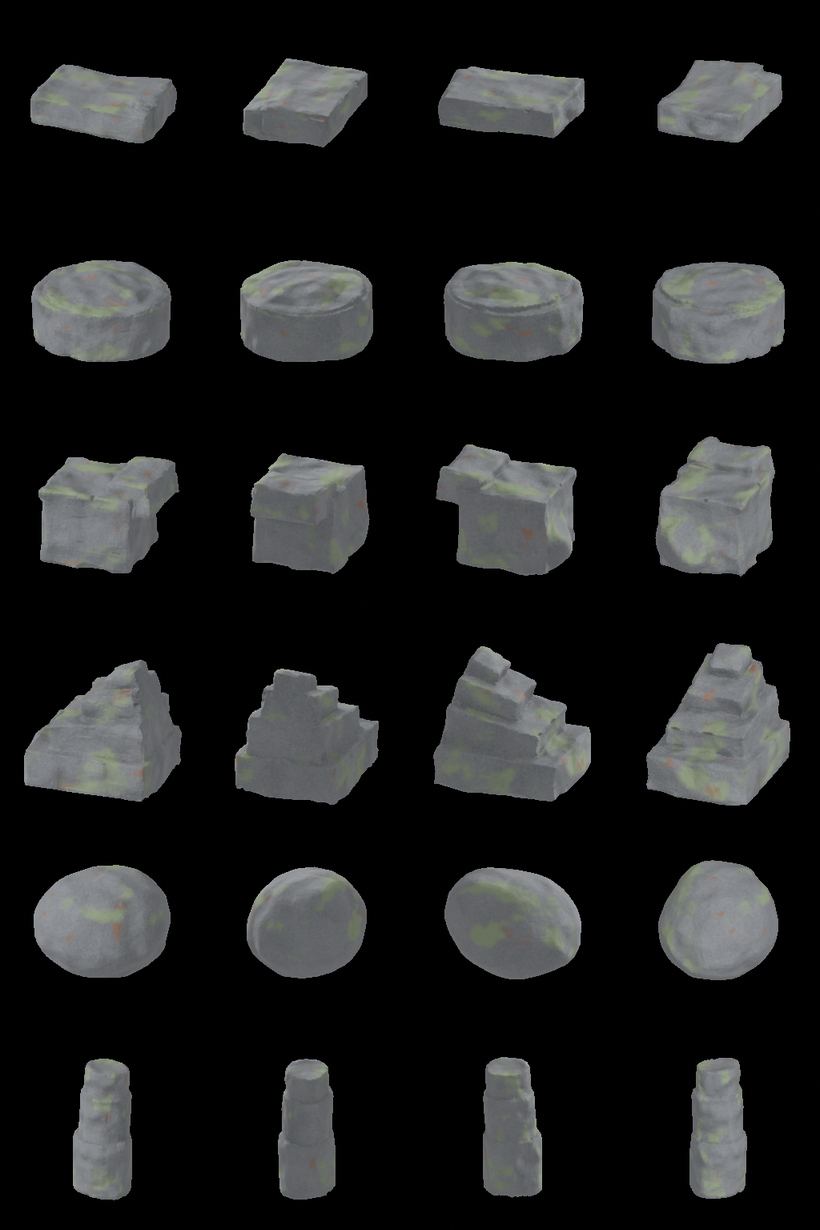
| Waystones sculpted and baked | 6, each high-poly to a low-poly hull (201-443 tris) |
| Collider source | every stone hull generated from its OWN baked mesh at load |
| Selftest playthrough | 8/8 stones, 2 lost, 1.44 m, win at t=408 s |
| Game time vs wall clock in audit | ~85% - this piece was never render-bound |
| Mocap clips used | none - no characters in this piece (P5 n/a) |
Six stone kinds with real mass, friction 0.92 and continuous collision. The cairn is held up by contacts, not by a script.
Every collider is generated from the stone's own baked mesh at load — the shape you see is the shape that balances.
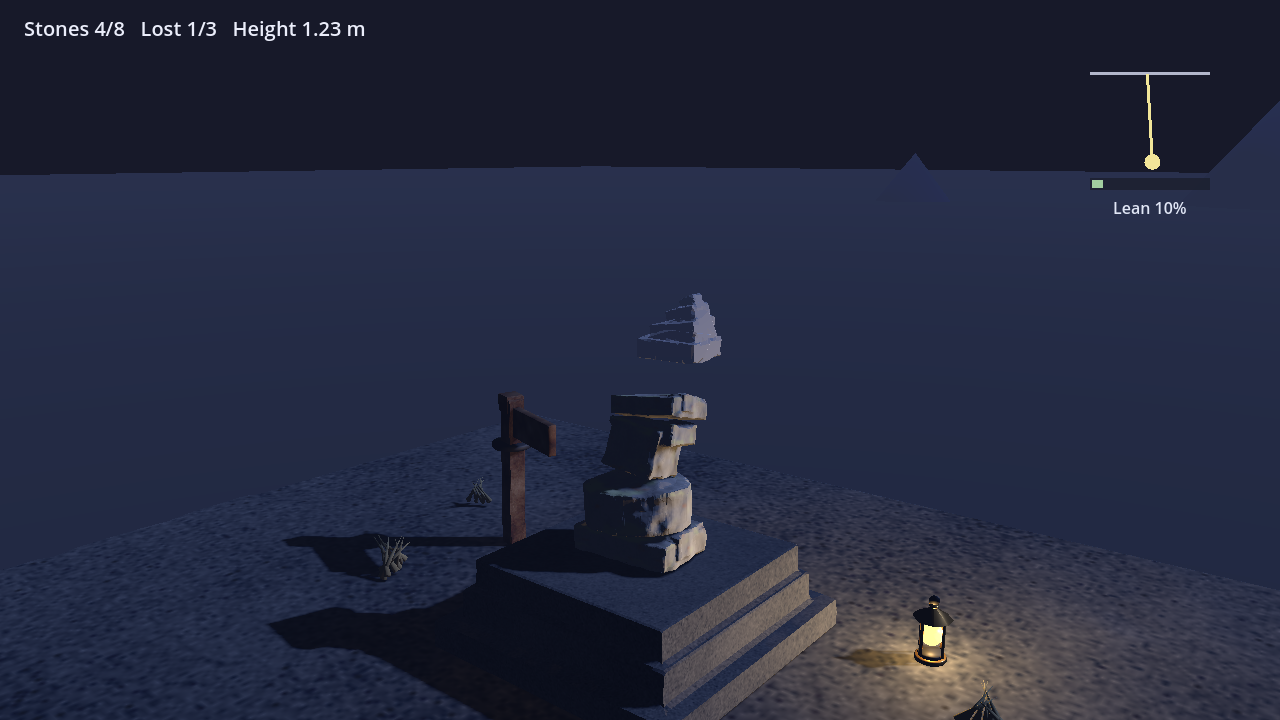
One cold DirectionalLight3D from the west drops the cairn's shadow across the rock: the shadow is how you read the lean.
The gust is a mass-scaled impulse plus a torque on every stone, weighted by height — the tall pillar you were proud of is the one that goes.
The shelf and the plinth collide as their own Blender meshes, so a stone that slides off lands on the rock it is drawn on.
Dust puffs under each landing, dry grass and grit streaking sideways through the gust.