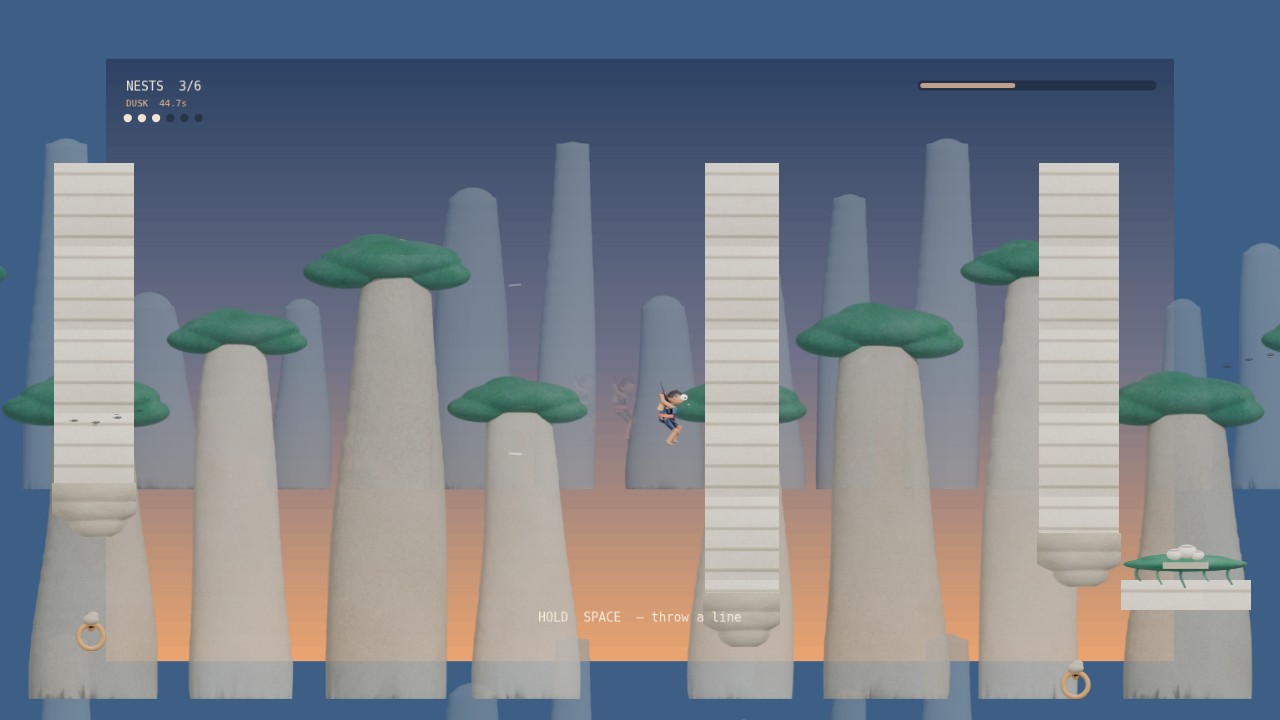
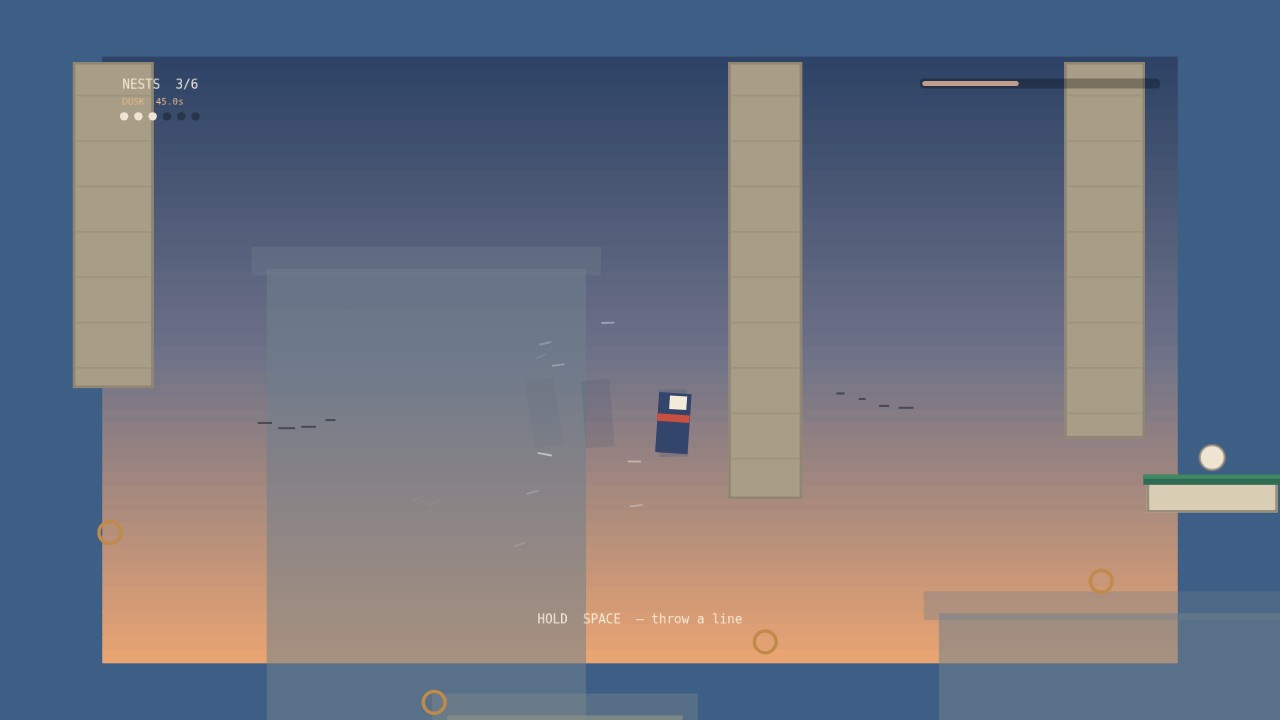
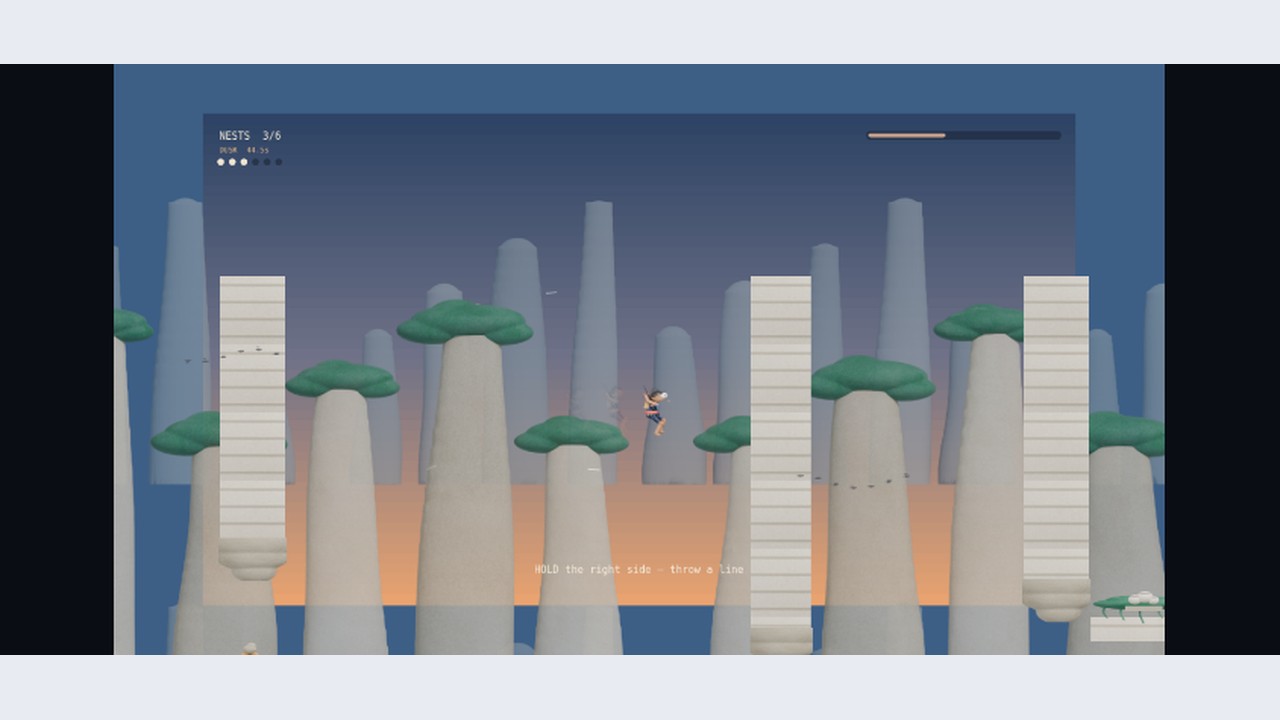
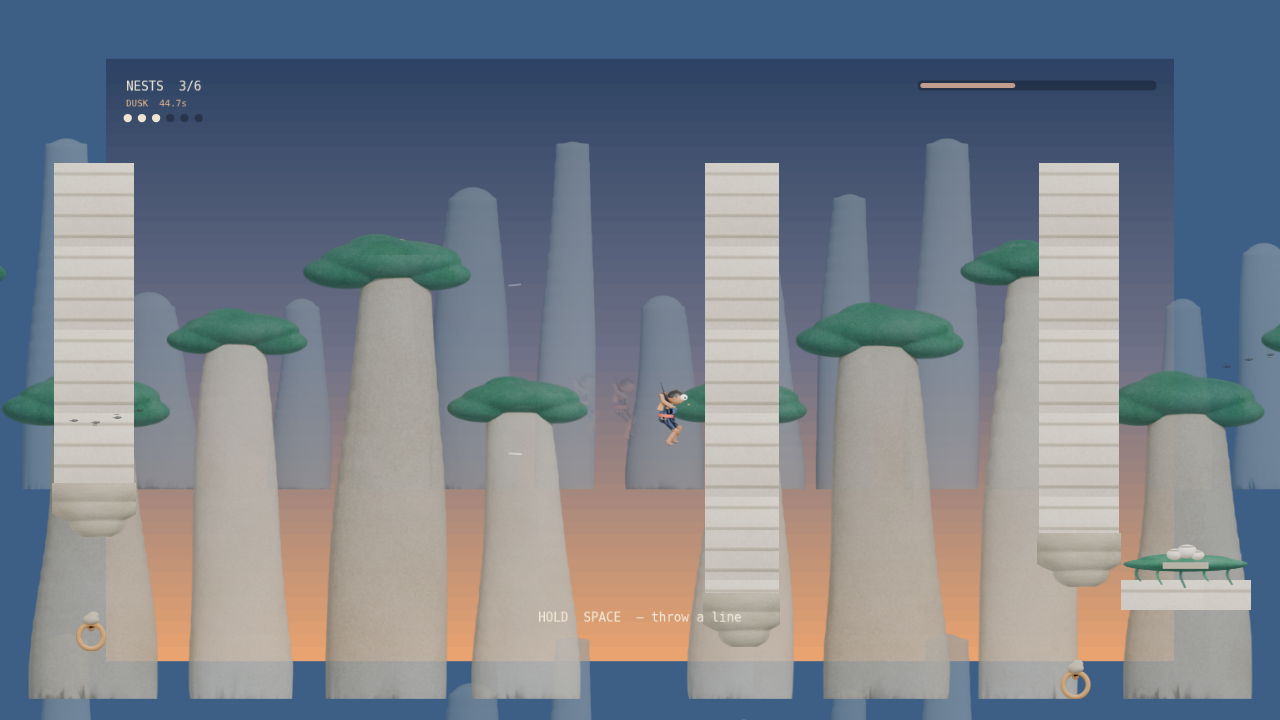
Dusk is coming down over a limestone gorge and the swiftlets are flying home. Throw a rattan line, swing, pump the arc, and let go at the right instant to carry your momentum to the next ring — six nests to gather and a roost to reach before the light goes. A complete momentum-traversal game authored end to end by AI agents on Phaser 4, physics hand-written so that every number in it could be measured.
Hold SPACE to throw and hold a line · A/D pump · W/S reel · touch: hold right, drag left · 3.4 MB to first frame (3.7 MB of instrument samples stream in behind it) · starts in seconds
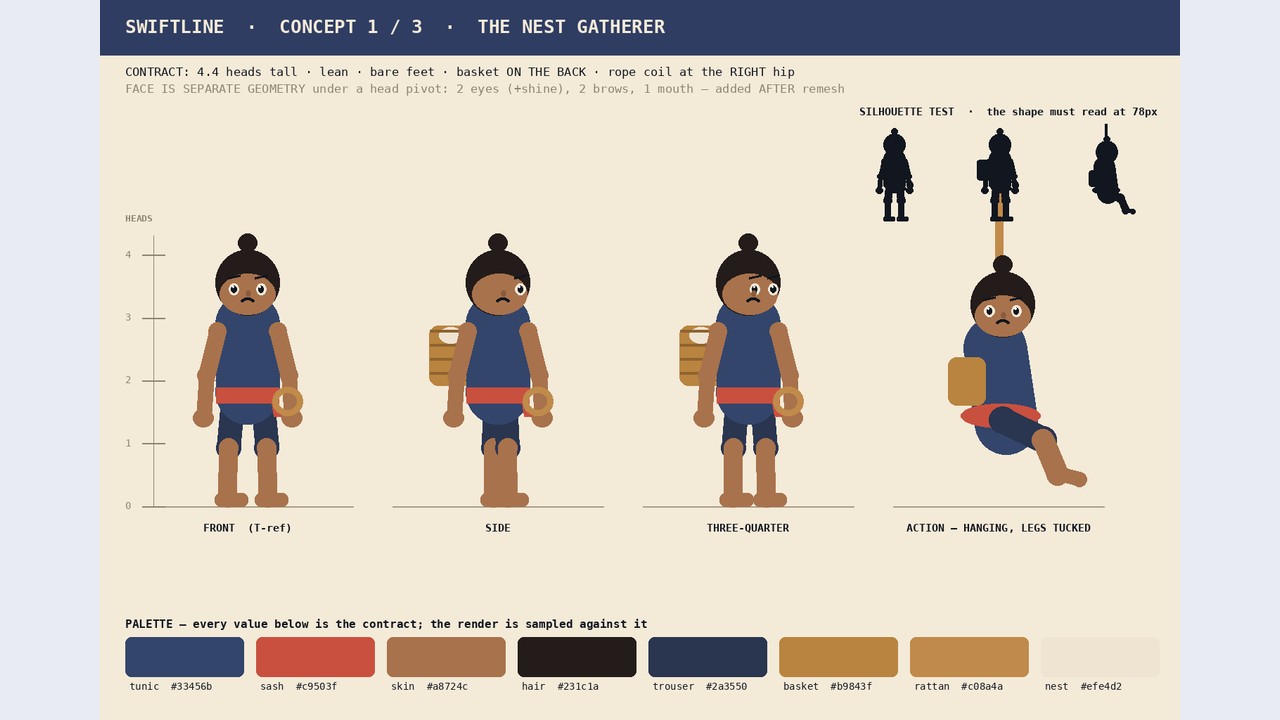
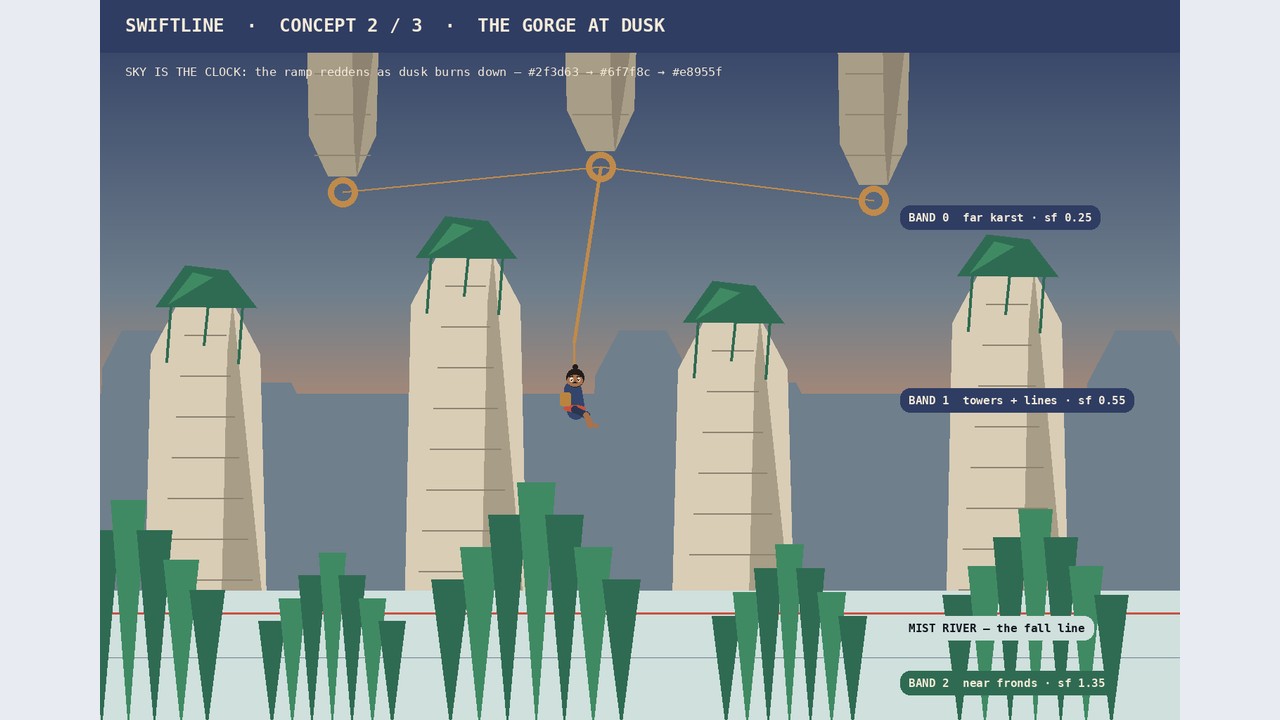
The platform's concept-image service was out of credits this cycle
(credit_balance_exhausted, logged in concept/gen.log), so the three
concept sheets were painted in-lab instead — which turned out to be the stronger contract.
Every colour on them is a named hex and every proportion is a stated measurement, so the
Blender build and the shipped file are checked against the sheet numerically rather than by
eye. The gorge sheet below fixes the three parallax bands, the mist fall-line and the rule
that the sky ramp IS the clock.


The whole gorge ran, and was crossed by an automated player, as gray boxes
before any art existed. The feel layer was tuned there: the rope constraint, the pump, the
reel, the two gravities, the speed-coupled camera. Then a reachability probe drove the shipped
step() directly — thousands of pumped-swing-and-release trials with no rendering
and no wall clock — and reported that a pumped swinger rises 202–558 px above its own ring
and carries up to 2353 px forward. Every nest and every spur ledge in the level sits on a
point one of those trials actually reached; closest approach is 0–10 px for all six.
Nests are not placed by eye in this piece.


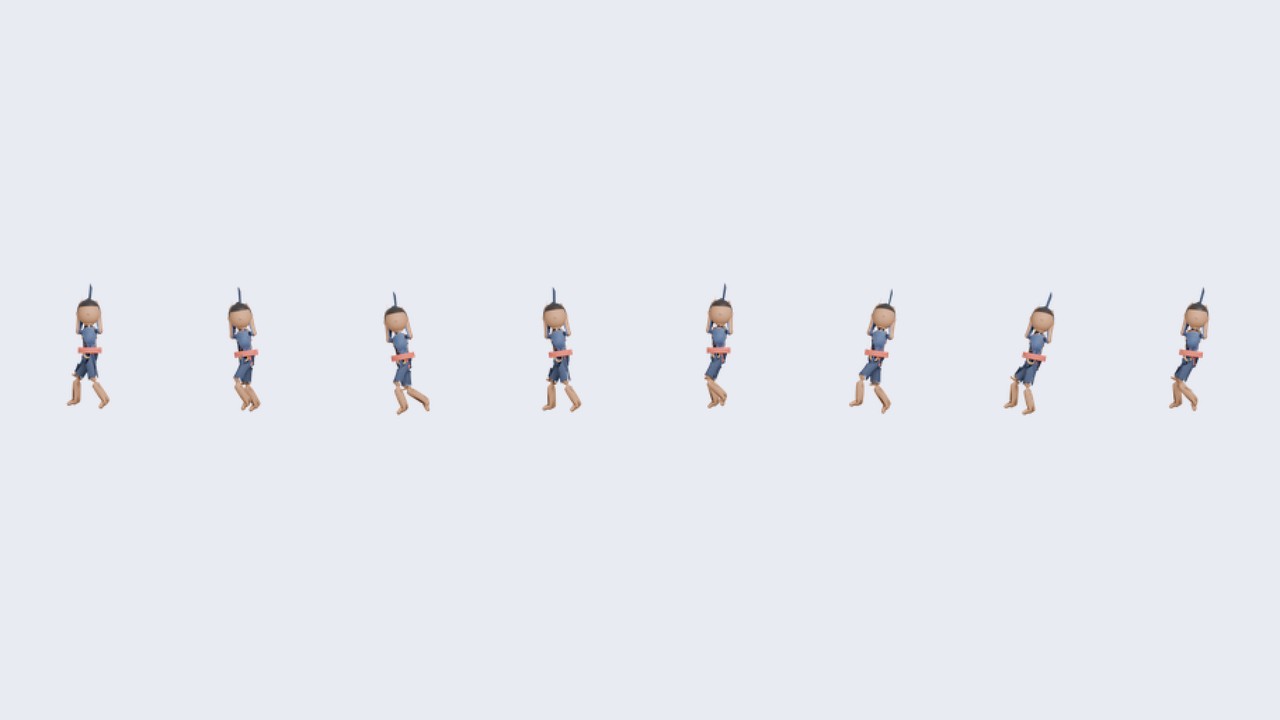
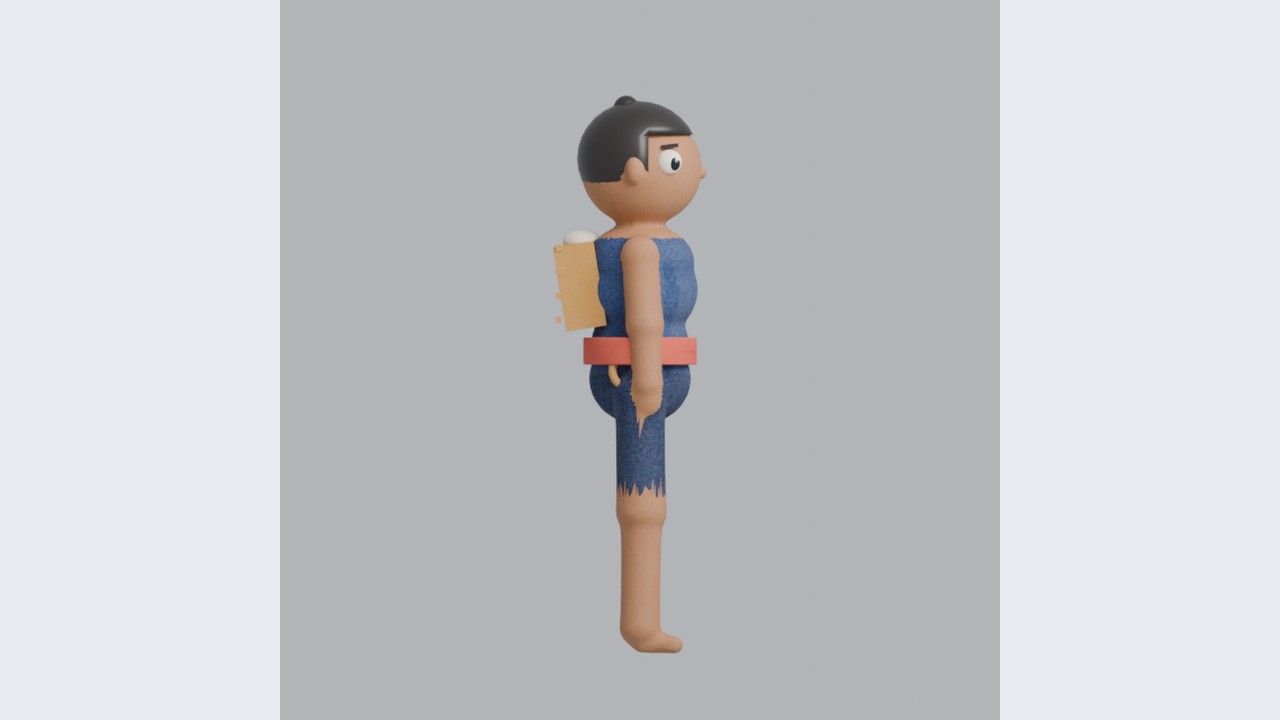
The gatherer is a code-built model — no sculpting by hand, no asset store. The swing cycle is motion capture, but not from one clip. The studio's curated library had no hanging motion at all, so the full CMU archive's own description index was read rather than guessing subject numbers — which found subject 43, "playground: grip bar, swing body". Retargeted and then measured frame by frame (wrist height against head height, torso verticality), that clip holds a usable hang for eight frames out of 181, and eight adjacent frames at 120 fps are the same picture: a cycle sampled from them fails an adjacent-frame difference gate, correctly.
So the cycle is composed. The arm chain is held at an overhead grip and legs and spine are driven by a locomotion clip (CMU 02_01), with the arm F-curves stripped out of the bake — because a keyed bone is re-evaluated from its action on every frame change and silently overwrites a pose set by hand. Arms locked on the line, legs scissoring fore-aft, and an authored hip sway and bob on top: which is what pumping a swing looks like. The shipped sheet passes the adjacent-frame gate at 6.17–9.70 against a threshold of 4.0 — it failed at 3.81 first, and the fix was to add the missing motion, never to lower the gate.
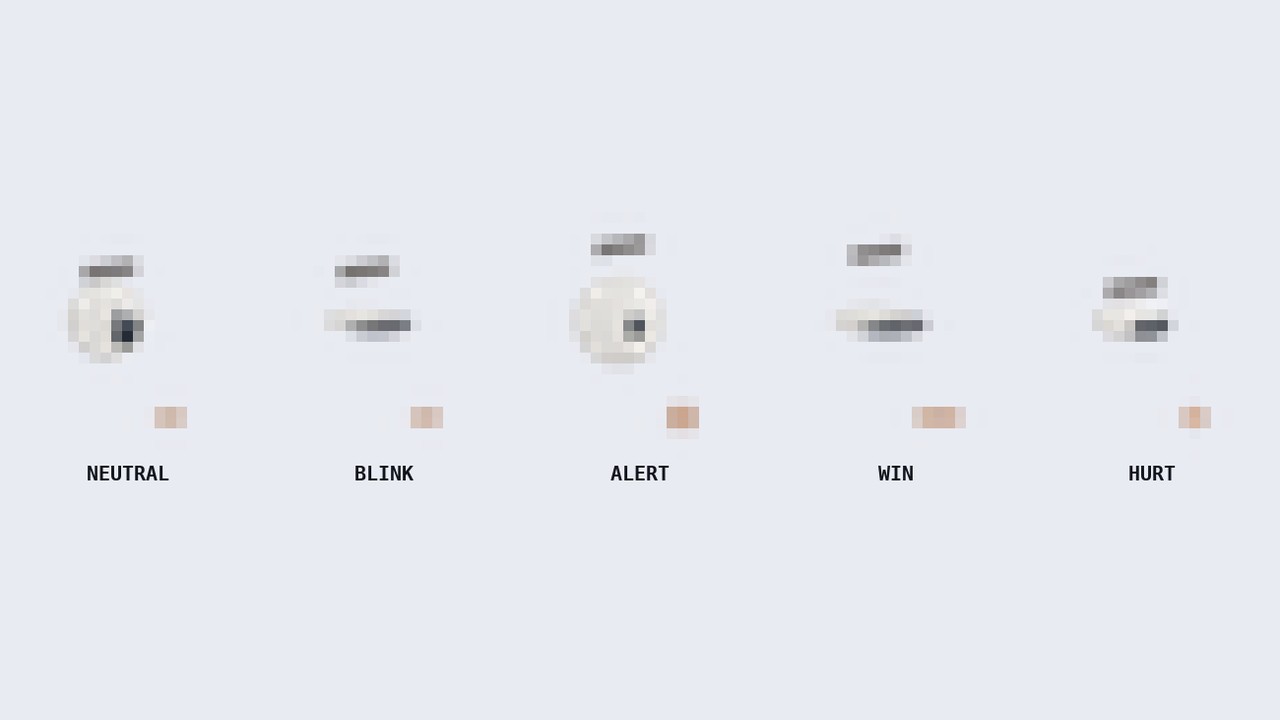
The face is not baked into the body sheet. It renders as its own five-state sheet — neutral, blink, alert, win, hurt — and the pipeline exports the head pivot in frame pixels for every body frame, so the engine composites the face onto any pose. That is what lets the character blink every few seconds and change expression mid-swing without multiplying the body sheet by the number of expressions.


This lab's output is not only the game — it is the numbers and the reasons. Every constant was A/B-swept against the shipped simulation, and the values that were thrown away were measured, not asserted. Two of the sweeps:
| Pump authority | Peak speed after 6 s | Direction reversals in 6 s | Verdict |
|---|---|---|---|
| 700 px/s² | 1441 px/s | 4 | Inert — nearly five seconds to get anywhere |
| 1150 px/s² — shipped | 1545 px/s | 5 | Reads as a pendulum; 3.5 s to full speed |
| 1600 px/s² | 1972 px/s | 8 | Starting to read as a motor, not a swing |
| 2400 px/s² | 2363 px/s | 10 | Ten reversals in six seconds — the arc is unreadable |
The reversal count is the readability metric: a pendulum reverses, a motor does not. The second sweep is the one that surprised us — reeling the line in conserves angular momentum, so pulling yourself up the rope at the bottom of the arc genuinely makes you faster, but only up to a point.
| Reel rate | Peak speed | Verdict |
|---|---|---|
| 0 px/s (pump only) | 1545 px/s | The baseline |
| 330 px/s — shipped | 1840 px/s | +19% over pumping alone |
| 700 px/s | 1711 px/s | Worse. The line bottoms out at its minimum and the swing collapses into a tight fast circle with no arc left to launch from |
Frame costs are from the audit box: a shared, GPU-less host running Chromium's software canvas renderer. That is the worst case this piece will ever see and the numbers are reported as measured, including the ones we would rather not print.
| Measurement | Result | Conditions |
|---|---|---|
| Input to response | 0–10.3 ms (8 samples) | Armed press → rope constraint applied, real keyboard path |
| Rope snap to feedback | 32.3 ms | Budget 100 ms |
| Nest pickup to feedback | 25.5 ms | Budget 100 ms; deliberately zero hit-stop |
| Camera kick settle | 240 / 270 / 306 ms | 4 / 9 / 15 px tiers to <0.4 px, zero overshoot |
| Rope snap hit-stop ladder | 26 / 54 / 84 ms | Radial closing speed 403 / 712 / 1034 px/s |
| Reachable envelope | 202–558 px above the ring | 19 rings × 90 pumped trials, shipped step() |
| Nest reachability | 0–10 px closest approach, 6/6 | Every nest sits on a trajectory a trial reached |
| Frame cost | 42.7 ms avg · 95.2 ms p95 | Best of 5 × 10 s of bot-driven play, raw performance.now() deltas, at host load average 39.6 — software canvas, GPU-less shared box. Every run is in audit/bench_runs.jsonl, including the ones at load 43 that measured 93 ms. |
| Payload | 3.4 MB to first frame · 5.5 MB total | Engine + scripts + sheets first; instrument samples stream in behind the first frame |
| Art rounds | model 4 · props 1 · environment 3 · sprite 5 · systems 4 | Model, props, environment, systems audits |
The unflattering row. 60 fps is not demonstrable on this audit box: it has no GPU, so Chromium falls back to a software canvas rasteriser and the frame cost we measure is dominated by rasterisation, not by the game. On real hardware the same build runs the WebGL renderer. We report what we measured rather than what we expect.
Position-based, taut-only, zero restitution — slack until it snaps.
Angular momentum conserved: shortening the line makes you faster.
The world pulls 1.26× harder while you are holding the line.
Zoom follows speed, deliberately slower than the position follow.
Critically damped along the rope normal. Translation only, rotation never.
Five states on a baked head pivot — blinks and reacts in any body pose.
No ambience bed anywhere: the air is a bowed-pad chord bed inside the score.
Every collectible placed on a trajectory a simulation trial actually reached.
The platform's new default for 2D; 23/23 API probes pass on canvas and WebGL.
A storm front is rolling over the rooftops and the laundry is still out. Run, jump and save all eight washing lines before the rain breaks — a complete precision platformer authored end-to-end by AI agents in the real Defold engine, and playing in seconds on a phone connection.
Arrows / WASD / touch · ~1.8 MB over the wire · starts in seconds
The piece was concepted first: a key-art sheet, a character turnaround and an environment callout board set the palette — terracotta caps, cream plaster, white linen, a slate-blue storm. Every named element in the sheets was then authored as a real asset.


The whole game ran and was beaten as gray boxes before any art existed — feel (coyote time, jump buffering, asymmetric gravity, camera lookahead) and the level's fall-recovery routes were tuned where changes cost minutes. An automated player drives every build through all eight lines to a verified win on each audit round.


The heroine is a rigged Blender character whose run and jump come from retargeted CMU motion capture, rendered to sprite rows. The washing lines are real cloth simulations — three wind phases baked into a flutter flipbook. Tiles, props, skyline ranks and the storm bank are all Blender renders packed into Defold atlases.
This lab exists to prove a real-engine game can be playing before a phone user loses interest. Every payload ships pre-compressed and is inflated in the browser, so any static host serves it optimally. Measured first-playable times, Playwright CDP network throttling:
| Connection profile | Throughput / RTT | First playable frame |
|---|---|---|
| Wi-Fi / 4G | 10 Mbps · 60 ms | 2.7–3.0 s |
| Fast 3G (HSPA+ class) | 6 Mbps · 150 ms | 3.5–4.4 s |
| Chrome DevTools “Fast 3G” preset | 1.44 Mbps · 562 ms | 12.2 s |
Total transfer 1.82 MB (engine 976 KB + game data ~0.8 MB, gzip + RDO-basis textures). Measured headless on software rendering — real devices boot faster.
Mocap-driven hero flipbooks; cloth flutter; props — all Blender-rendered, basis-compressed.
Hand-generated tilemap with per-tile collision hulls; raycast locomotion against them.
Washing lines are trigger collision objects; the player body raycasts the world.
Chimney smoke, wind-blown leaves, and a full-screen rain front — hand-written particlefx.
Resolution-independent HUD laid out in physical pixels — one layout from desktop to phone portrait.
Factories spawn lines and scenery; every system talks via msg.post — no globals.